Key points
- Check the menu online and call ahead outside busy hours, so ordering feels less rushed.
- Sauces, dressings, marinades, stocks and curry pastes are where garlic and onion most often hide.
- Plainly cooked protein with rice, potato, salad or vegetables is usually the easiest meal to adapt.
- FODMAPs can stack up across a day, so a lighter-FODMAP breakfast and lunch can leave room for dinner out.
- You are allowed to ask for what you need. Most kitchens are used to requests.
How do you eat out when you have IBS?
The most reliable way to eat out with IBS is to plan a little ahead, choose simply cooked dishes, and ask about sauces, dressings and marinades, since that is where common triggers like garlic and onion tend to hide. Monash University, the team behind the low-FODMAP approach, suggests checking menus online, naming your main triggers to staff, and asking for sauces on the side.
Eating out should still feel like a treat, not a test. This guide walks through planning, reading a menu, what to ask for, portions, and cuisine-by-cuisine ideas. It assumes you already know some of your triggers, perhaps from working through a low-FODMAP approach with a dietitian.
If you also have a food allergy or celiac disease, the stakes are different. See talking to restaurant staff about allergies and eating out with celiac disease. Always tell staff about an allergy, every time, and carry any medication you have been prescribed.
Plan ahead to lower the stress
Monash notes that stress can be a trigger for IBS symptoms in some people, so a bit of planning helps your gut as well as your nerves.
- Look at the menu online. Find two or three dishes that look adaptable, and note anything that says allergies or special requirements are catered for.
- Call outside busy hours. Monash suggests phoning ahead to give the kitchen a heads-up, especially if your request is complicated.
- Pick your non-negotiables. Decide which triggers you need to avoid completely and which you can tolerate in small amounts.
- Plan the rest of your day. Keep breakfast and lunch on the lower-FODMAP side (more on that below).
- Have a fallback. Know which plain sides you could combine into a meal if nothing on the menu works.
If eating out has started to feel daunting, you are far from alone. Our guide to food anxiety and digestive conditions has ideas for easing that worry.
Sauces, marinades and what to ask for
Garlic and onion are the most common hidden FODMAPs in restaurant food. They show up in marinades, stocks, dressings, dips and the base of most sauces. Our guide to hidden garlic and onion has a full list.
Short, specific questions get the clearest answers. You might try:
- "Is there garlic or onion in the sauce or marinade?"
- "Could I have the chicken grilled plain, with just salt, pepper and olive oil?"
- "Can the dressing come on the side?"
- "Is the soup or risotto made with a stock that has onion in it?"
- "Could I swap the bread or pasta for rice, potatoes or a salad?"
- "What would you recommend that avoids garlic, onion and wheat?"
Asking for sauces and dressings on the side lets you decide how much to use. Monash also suggests that ordering a gluten-free dish can be a shortcut for avoiding wheat, as long as you also ask about your other triggers. Bear in mind that a gluten-free dish is not automatically low in FODMAPs, and gluten-free is not the same as celiac-safe (see gluten-free vs celiac-safe).
Monash puts it simply: you have the right to ask for what you need. A brief, friendly explanation such as "I have a digestive condition and garlic and onion make me unwell" is usually enough.
Portions and FODMAP stacking
FODMAPs add up. A small serving of one food might sit well, but several moderate-FODMAP foods in one meal, or across a day, can tip you over your threshold. Monash suggests eating as low-FODMAP as possible earlier in the day when you know you are eating out at night, to reduce the build-up effect.
- Share or skip a course. Restaurant portions are often larger than what you would serve at home.
- Mind the extras. Bread baskets, dips, sauces and desserts all add to the total.
- Eat slowly. The NIDDK suggests eating slowly and having smaller, more frequent meals to help with gas, and limiting fizzy drinks.
- Take your time with drinks. Carbonated drinks add swallowed gas, so still water alongside is a gentle choice.
Our guide to FODMAP portion sizes explains why the same food can be fine at one serving and a trigger at another.
Cuisine-by-cuisine ideas
These ideas come mainly from Monash’s guides to Italian, Chinese, French and Indian and Asian-style dining. They are starting points, not guarantees, since every kitchen cooks differently.
| Cuisine | Often easier | Ask about |
|---|---|---|
| Italian | Gluten-free pasta or pizza bases with simple toppings; risotto | Garlic or onion in the passata; garlic on bianco bases; the risotto stock |
| Chinese | Rice-based dishes with plain stir-fried meat and vegetables | Onion, garlic or sweeteners in sauces; spring onion garnish (green part only) |
| French | Steak frites with mustard; salad with oil and vinegar | Pan sauces; shallots and croutons in salads |
| Indian | Freshly cooked vegetarian or seafood dishes; plain rice | Curry pastes, which often contain onion or shallots |
| Thai | Stir-fries with no onion or garlic and steamed jasmine rice | Curry pastes; chili level if heat bothers you |
| Vietnamese | Rice vermicelli bowls; rice paper rolls | Onion in the bowl; fish sauce on the side |
| Japanese | Grilled fish, tofu or chicken with steamed rice; sashimi | Sauces and condiments on the side |
| Korean | Barbecue you cook at the table | Marinades on the meat |
Monash points out that wheat noodles such as Hokkien or chow mein, and wonton wrappers, contain fructans, so rice, rice noodles and potatoes are often simpler swaps. Thai and Vietnamese kitchens also use chili freely; Monash notes that chili can still bother some people even though it isn’t a FODMAP, so it’s fine to ask for a mild version.
Whatever the cuisine, the pattern is similar: plainly cooked protein, a simple starch, vegetables you tolerate, and sauces on the side. Once you know that pattern, almost any menu has something you can work with.
Cafés, takeout, work events and friends’ homes
Not every meal out is a sit-down restaurant with a patient server. The same principles work in quicker, more social settings, with a little adjustment.
- Cafés and coffee shops. Pastries, sandwiches and wraps are usually wheat-based, and milk drinks contain lactose. If those bother you, eggs, rice bowls or salads with dressing on the side are often easier, and many cafés offer lactose-free or plant-based milk. Ask which plant milk they use, since tolerance varies.
- Takeout and delivery. Use the restaurant’s notes field to ask for no garlic or onion and sauces on the side, then check the order when it arrives. If an app lists ingredients, read them, but don’t rely on them alone.
- Work events and catering. Let the organizer know your needs early. If you can’t be sure what will be served, eat something you tolerate ahead of time so you aren’t arriving hungry.
- Friends’ and family homes. Most hosts would rather know. Offer to bring a dish you can eat and share, and keep requests specific: "no garlic or onion" is easier to cook for than "low-FODMAP".
- Celebrations. Choose one or two things you really want to enjoy, and keep the rest of the plate simple. That way the occasion is about the company, not the menu.
If you care for someone with IBS or other food restrictions, our guide to caring for someone with food restrictions has ideas for hosting without stress.
If symptoms flare anyway
Even with careful choices, you can’t control everything in someone else’s kitchen. A flare doesn’t mean you did anything wrong.
- Note what you ate and how you felt in a food and symptom diary. Patterns over several meals tell you more than any single night.
- Return to your usual, well-tolerated meals for the next day or so.
- If you notice the same dish or ingredient causing trouble, mention it to your dietitian.
- See your doctor if your symptoms change, get worse, or come with unexplained weight change, bleeding, fever or vomiting.
For trips further afield, see traveling with food intolerances.
How SafeBelly helps
Know before you eat.
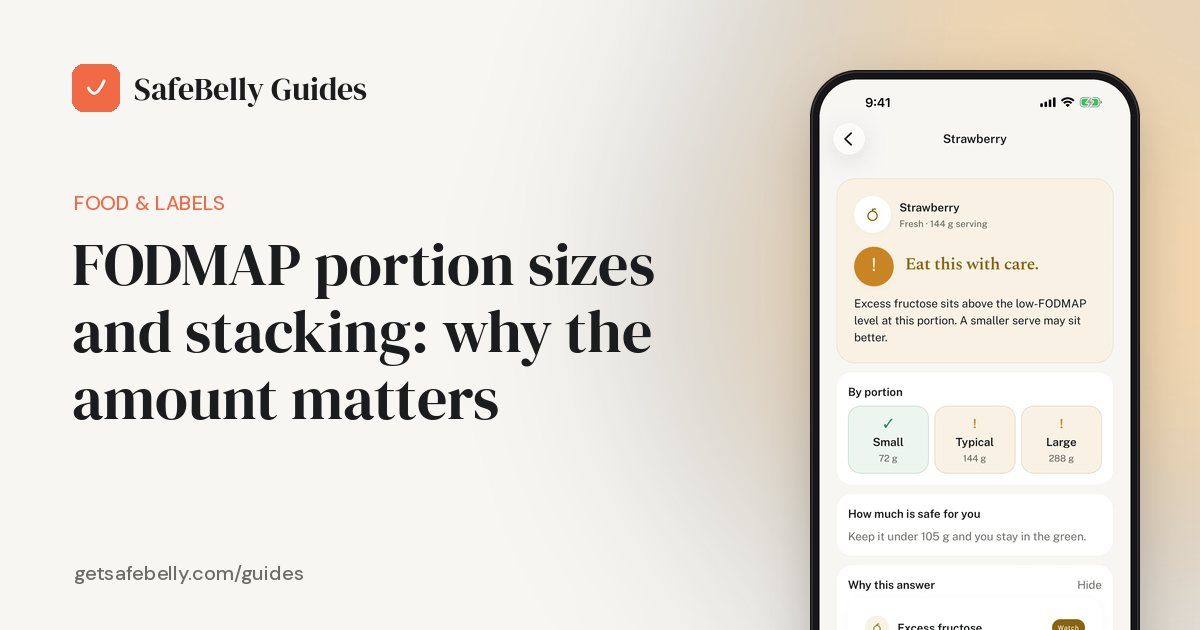
Ahead of ordering, you can search a dish in SafeBelly or photograph your plate to see whether it’s a "Yes", "Eat this with care" or "No" for the conditions you’ve chosen, with the reason. For FODMAP-based conditions it shows small, typical and large portions, which helps with stacking, and every check includes the 14 major allergens. It’s a food information app, so the kitchen’s own answers still come first.
SafeBelly is in final testing on iPhone and Android. Leave your email and we'll send one note the day it's in the App Store and on Google Play.
Frequently asked questions
What can I eat at a restaurant with IBS?+
Plainly cooked fish, chicken, steak, eggs or tofu with rice, potatoes, salad or vegetables are usually the easiest dishes to adapt. Ask for sauces and dressings on the side, and check whether marinades or stocks contain garlic or onion. Your own triggers matter most, so build on what you know you tolerate.
How do I ask a restaurant for no garlic or onion?+
Keep it short and specific: "I can’t have garlic or onion. Is there any in the sauce or marinade, and could it be cooked plain?" Calling ahead outside busy hours gives the kitchen more time to help.
What is FODMAP stacking?+
Stacking is when several small or moderate servings of FODMAP-containing foods add up in one meal or one day. Monash suggests keeping meals earlier in the day lower in FODMAPs when you know you’re eating out later.
Which cuisines are easiest with IBS?+
It depends on your triggers. Japanese, Vietnamese and Korean barbecue often offer simple, rice-based options, and Italian restaurants increasingly offer gluten-free bases. Dishes built on curry pastes or long-simmered sauces are usually harder to adapt.
Is gluten-free food low FODMAP?+
Not always. A gluten-free dish removes wheat, but it can still contain garlic, onion or other FODMAPs in its sauce or seasoning. Ask about your other triggers too.
Should I tell the server I have IBS?+
You don’t have to explain a diagnosis. Naming the specific ingredients you need to avoid is clearer for the kitchen. If you have a food allergy, always say so directly, since that changes how the kitchen prepares your food.
Sources
- Eating out tips and tricks · Monash University FODMAP
- Eating out on a low FODMAP diet · Monash University FODMAP
- Eating out on a low FODMAP diet: Italian, Chinese, French and Indian · Monash University FODMAP
- Dining out on a low FODMAP diet: Asian cuisine · Monash University FODMAP
- Starting the low FODMAP diet · Monash University FODMAP
- Eating, Diet, & Nutrition for Gas in the Digestive Tract · National Institute of Diabetes and Digestive and Kidney Diseases (NIDDK)
SafeBelly is a food information app, not a medical device, and no substitute for professional medical advice. Talk to your doctor or a registered dietitian before making changes to how you eat, and seek urgent care for severe or sudden symptoms.