Key points
- A food and symptom diary helps you and your clinician see patterns that memory alone tends to miss.
- Log food and drink, symptoms, bowel habits, stress, sleep and medicines, with times for each.
- Two to four weeks is usually enough to see patterns; keep it short and purposeful.
- One rough day rarely proves a food is a trigger; look for repeats and talk results through with a professional.
- If tracking starts to feel compulsive or frightening, simplify it or pause it.
What is a food and symptom diary for IBS?
A food and symptom diary for IBS is a short-term daily record of what you eat and drink, the symptoms you notice, your bowel habits, and things like stress and sleep, kept so you and your clinician can look for patterns. The NHS suggests keeping a diary of what you eat and any symptoms you get as one of the first practical steps for managing IBS (NHS).
The International Foundation for Gastrointestinal Disorders (IFFGD) describes its own Personal Daily Diary as a way to understand how your body may be reacting to things like food, exercise, stress and sleep, so that you and your physician can decide on the best treatment options (IFFGD).
A diary is a tool for understanding, not a test you can pass or fail. Its job is to give you and your care team clearer information, then step aside.
What to log: a simple template
IFFGD's diary covers stool consistency and frequency, pain, gas, food, beverages, medication, emotional state, exercise and, for women, the menstrual cycle (IFFGD). You do not need to capture everything perfectly. Consistent, simple entries are more useful than detailed entries you abandon in a week.
| What to log | What to note | Why it helps |
|---|---|---|
| Food and drink | Time, what you had, rough portion, how it was cooked, sauces and seasonings | Ingredients like garlic and onion hide in sauces and stocks; portion size can matter |
| Symptoms | Time, type (pain, bloating, gas, urgency, nausea), and a 0 to 10 rating | Lets you compare days and see whether symptoms are easing over time |
| Bowel movements | Time and stool type using the Bristol Stool Chart; urgency or straining | Gives your clinician a shared language for describing changes |
| Stress and mood | A word or two, or a quick 0 to 10 rating | IFFGD's diary includes stress and emotions alongside food |
| Sleep and activity | Rough hours slept; any exercise | IFFGD's diary includes sleep and exercise as possible influences |
| Medicines and supplements | Prescription and over-the-counter, including herbal products | Your clinician needs the full picture to interpret changes |
| Menstrual cycle (if relevant) | Day of cycle | IFFGD's diary includes it because symptoms can shift across the cycle |
Log meals soon, while you still remember the details. A photo of your plate is a quick backup when you can't write it down straight away.
About the Bristol Stool Chart: Cleveland Clinic explains that it sorts stool into seven types, from separate hard lumps (type 1) to fully liquid (type 7). Types 1 and 2 point toward constipation and types 5 to 7 toward diarrhea. Clinicians use it to describe consistency and track change over time, and it saves you from having to find the words (Cleveland Clinic).
How long should you keep a food diary for IBS?
IFFGD suggests using its daily diary for 2 to 4 weeks (IFFGD). That is long enough to include ordinary weekdays, weekends, a few meals out and a range of stress levels, and short enough to stay sustainable.
There are a few times when a more focused diary is useful for longer, all best done with a clinician guiding you:
- Ahead of a first appointment with a doctor or gastroenterologist, so you can describe your symptoms clearly.
- During a structured approach such as the low-FODMAP diet, especially the reintroduction step.
- When something changes, such as a new medicine, so you can see whether symptoms shift.
Once the diary has answered its question, you can stop. A diary that runs indefinitely tends to stop producing new information and can start producing worry instead.
Spotting patterns without over-reading them
IBS symptoms vary from day to day for many reasons, and not every rough evening is caused by lunch. The most useful patterns are ones that repeat. A few principles keep you from blaming the wrong food:
- Look for repeats, not one-offs. A food that seems linked to symptoms on three separate occasions is more meaningful than one rough evening.
- Check the whole meal. If a sandwich seemed to cause trouble, was it the bread, the filling, the sauce or the portion? Our guides to hidden garlic and onion and high-FODMAP foods and swaps can help you spot likely culprits.
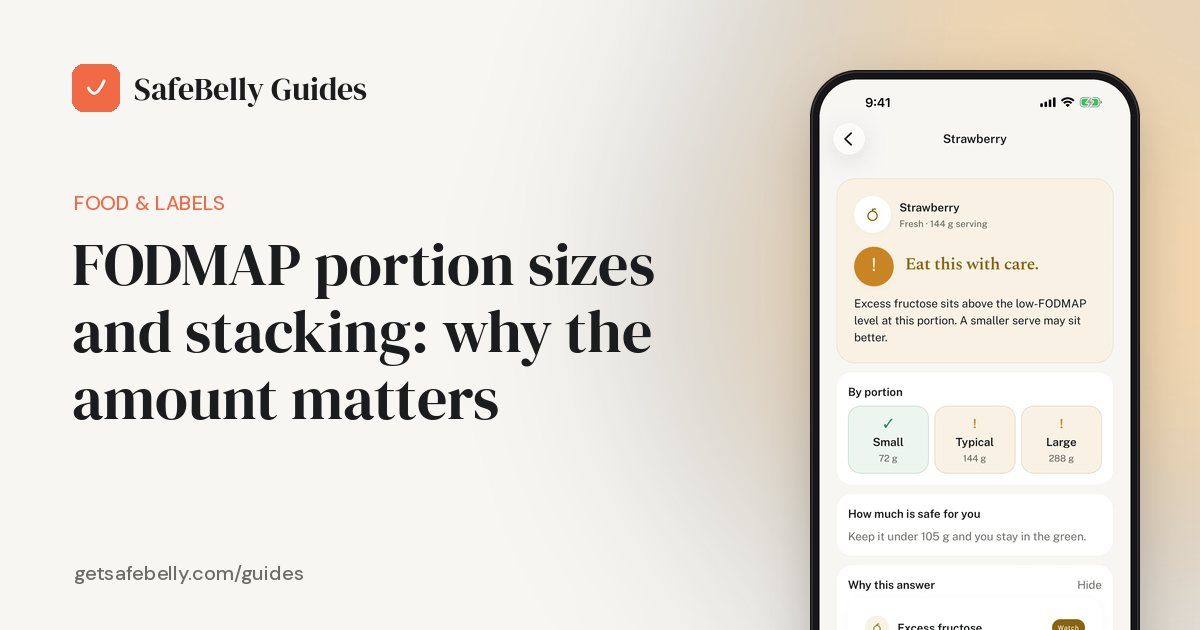
- Consider dose. With FODMAPs, a small serving may sit well while a large one does not. See FODMAP portion sizes.
- Look at stress, sleep and your cycle too. Sometimes the pattern is a busy week or a short night, not a food.
- Notice what goes well. Mark the meals and days that felt comfortable. They are data too, and they help keep the picture balanced.
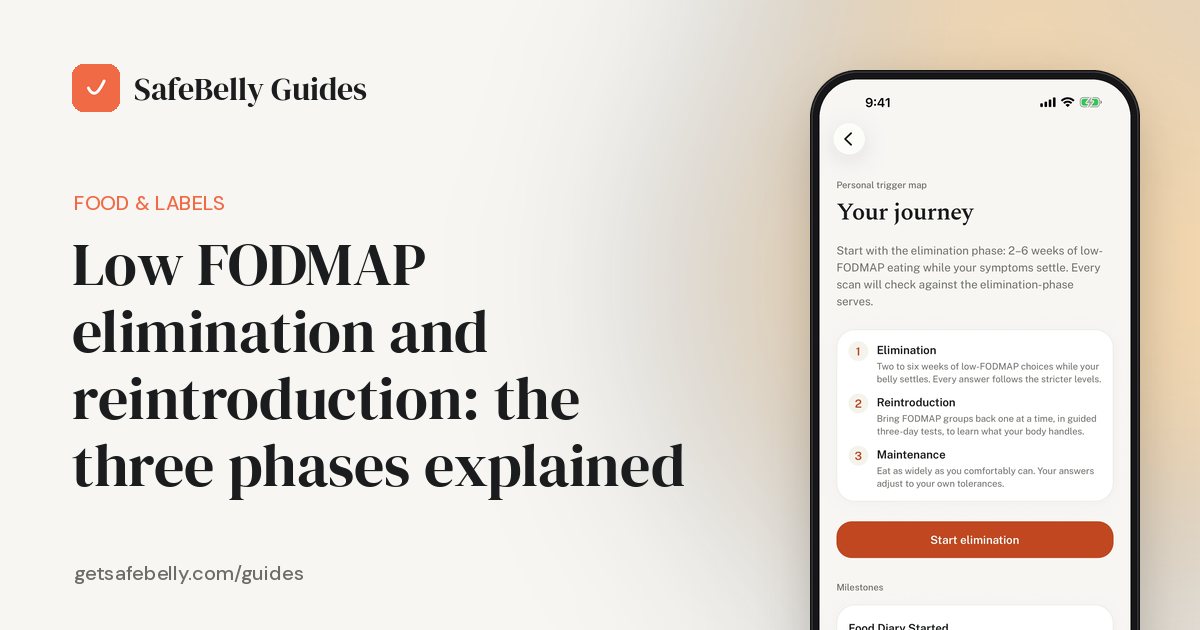
Testing a suspected trigger works best one food at a time and in a planned way. In Monash University's FODMAP reintroduction approach, each FODMAP group is tested separately over three days with increasing serving sizes, at about the same time each day, with a break of 2 to 3 days (or until symptoms settle) between challenges (Monash FODMAP). Monash recommends doing this with a trained dietitian, who can help interpret the results. You can read more in the low-FODMAP phases explained.
Please don't cut out foods based on a diary alone. Talk to your doctor or a registered dietitian first, so you don't lose foods you actually tolerate.
Keeping tracking helpful, not obsessive
For some people, a diary brings relief. For others, it can quietly turn into constant monitoring. Monash University's FODMAP team lists "constantly monitoring and recording food intake" and fixating on food choices among the signs that IBS-related eating may be tipping into disordered eating (Monash FODMAP).
- Set an end date when you start, and stick to it unless your clinician suggests otherwise.
- Log facts, not judgments. "Pasta, two cups, 7 pm" rather than words that blame yourself.
- Skip the numbers you don't need. Rough portions are enough; there is no need to weigh every meal.
- Keep meals social. If logging is stopping you eating with others, simplify it.
- Pause if it raises anxiety. If filling it in makes you more scared to eat, stop and tell your care team.
If food fear is growing, our guide to food anxiety with IBS covers the gut-brain connection, ARFID awareness and where to get support.
How SafeBelly helps
Know before you eat.
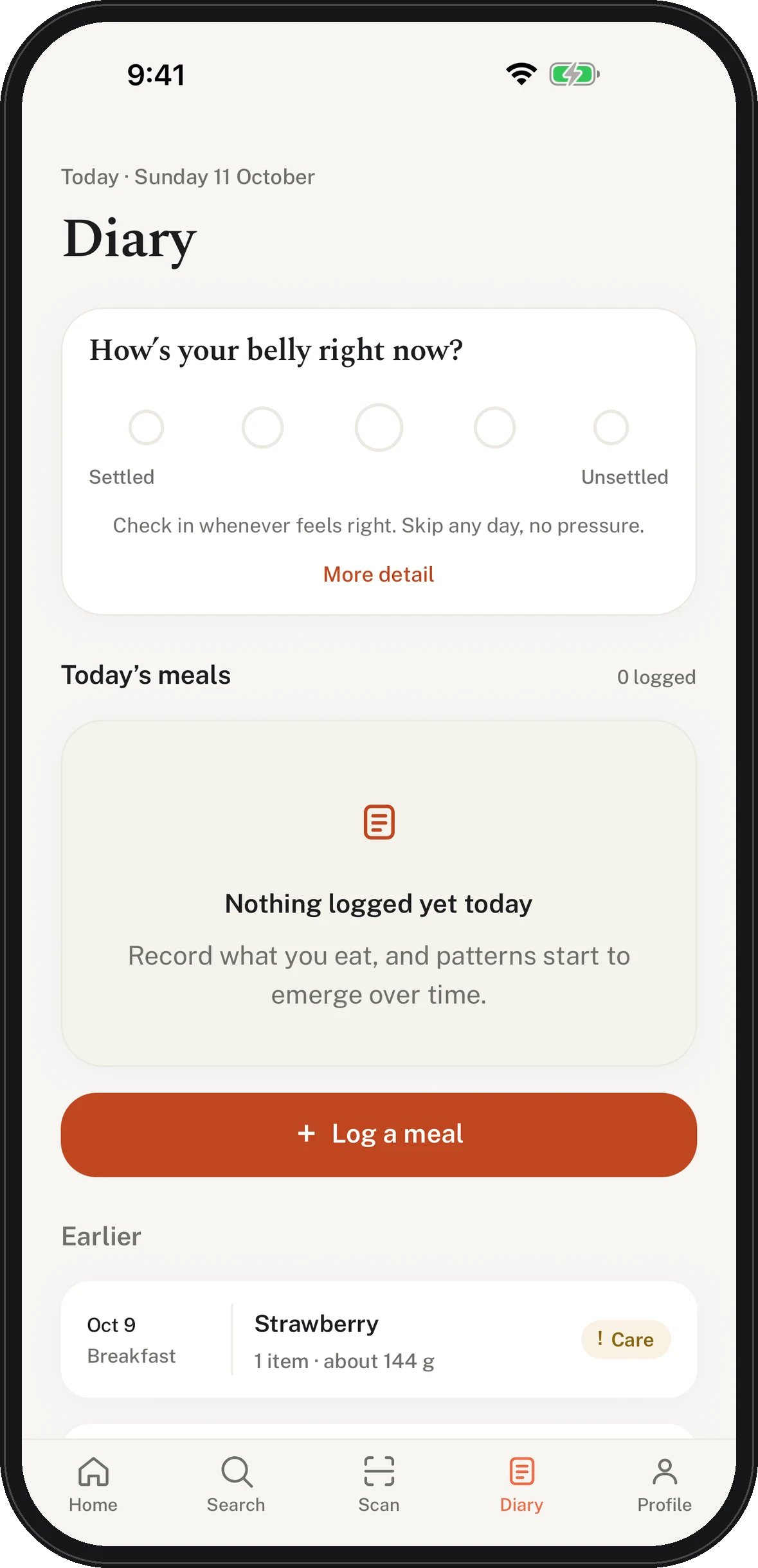
SafeBelly's diary lets you log meals by searching, scanning a barcode or photographing a plate, with a one-tap "How's your belly?" check-in instead of long forms. You can export your entries as a CSV to share with your doctor or dietitian. It is a food information app, not a medical device, and it is there to support your clinician's guidance, not replace it.
SafeBelly is in final testing on iPhone and Android. Leave your email and we'll send one note the day it's in the App Store and on Google Play.
Frequently asked questions
What should I write in an IBS food diary?+
Record what you eat and drink with times and rough portions, your symptoms with a simple rating, your bowel movements (the Bristol Stool Chart helps), and notes on stress, sleep, exercise and medicines. IFFGD's free diary is a good template to start from.
How long should I keep a food and symptom diary?+
IFFGD suggests 2 to 4 weeks for a daily symptom diary. That is usually enough to show patterns across different days and situations. A longer, more focused record may be useful during a guided low-FODMAP reintroduction.
How soon do IBS symptoms start once you've eaten?+
It varies from person to person and food to food, which is why noting the times of meals and symptoms is useful. Rather than assuming a fixed window, look for timing that repeats in your own diary and talk it through with your clinician or dietitian.
Should I stop eating a food that shows up in my diary?+
Not on the strength of the diary alone. One rough day can have many causes, including stress and sleep. Talk to your doctor or a registered dietitian, who can help you test suspected triggers in a structured way so you keep the foods you tolerate.
Is there an app for an IBS food and symptom diary?+
Yes, several apps include a food and symptom diary, including the Monash FODMAP app and SafeBelly. A paper diary like IFFGD's printable template works just as well. Choose whichever you will actually keep up with.
What if keeping a food diary makes me anxious?+
Simplify it, shorten it, or pause it. Constant monitoring of food can become part of the problem for some people. Let your doctor or dietitian know, as they can suggest a lighter approach or other support.
Sources
- Irritable bowel syndrome (IBS): Diet, lifestyle and medicines · NHS
- Irritable bowel syndrome (IBS): Symptoms · NHS
- Symptom Diary – An Easy Tool for You · International Foundation for Gastrointestinal Disorders (IFFGD), About IBS
- Bristol Stool Chart · Cleveland Clinic
- Practical tips for Step 2: FODMAP Reintroduction · Monash University FODMAP
- Disordered Eating in Irritable Bowel Syndrome · Monash University FODMAP
SafeBelly is a food information app, not a medical device, and no substitute for professional medical advice. Talk to your doctor or a registered dietitian before making changes to how you eat, and seek urgent care for severe or sudden symptoms.