
Key points
- FODMAPs are short-chain carbohydrates that some people with IBS find hard to tolerate.
- The low FODMAP approach has three phases: a short low FODMAP phase, reintroduction, then personalization.
- It is a learning tool to find your triggers, not a way of eating for life.
- Work with your doctor and a FODMAP-trained dietitian, ideally before you change what you eat.
- Swapping foods, not skipping meals, is the heart of the first phase.
What is the low FODMAP diet for IBS?
The low FODMAP diet for IBS is a short, structured approach that swaps foods high in certain fermentable carbohydrates (FODMAPs) for lower FODMAP alternatives for a few weeks, then brings them back one group at a time to learn which ones trigger your symptoms. The goal is the least restrictive way of eating that still keeps your symptoms settled. Monash University, where the approach was developed, describes it as a 3-step plan for managing symptoms of medically diagnosed irritable bowel syndrome (IBS), such as abdominal pain, bloating, wind and changes in bowel habit (Monash FODMAP).
It is a tool for managing symptoms, not a cure, and it doesn’t help everyone. Monash reports that about three in four people with IBS find their symptoms improve on the approach, while about one in four do not and may need other therapies (Monash FODMAP).
Major gastroenterology guidance supports trying it. The American College of Gastroenterology’s IBS guideline recommends “a limited trial” of a low FODMAP diet to improve overall IBS symptoms (ACG Clinical Guideline, PubMed). The word *limited* matters, and we’ll come back to it.
If you haven’t been diagnosed with IBS, start with your doctor. Symptoms like these can have other causes, and some tests (for example, celiac testing) work best while you are still eating your usual foods.
What are FODMAPs, and why do they cause symptoms?
FODMAP stands for Fermentable Oligosaccharides, Disaccharides, Monosaccharides And Polyols. These are short-chain carbohydrates (sugars) that aren’t fully absorbed in the gut. They occur naturally in many everyday foods and in some food additives (Monash FODMAP).
Monash explains the process in three steps. FODMAPs move slowly through the small intestine and draw water in with them. When they reach the large intestine, gut bacteria ferment them and produce gas. The extra water and gas stretch the bowel wall (Monash FODMAP).
This happens in everyone, and most people eat high FODMAP foods with no trouble. The difference in IBS is that the gut may move contents along at a different pace and the bowel wall may be more sensitive, so the same stretch can feel like pain, bloating or urgency (Monash FODMAP). A 2024 review in *Nutrients* adds that symptoms may depend more on sensitivity to that stretch than on the amount of gas itself (Bertin et al., 2024).
The FODMAP groups, with everyday examples
FODMAPs are usually discussed as five subgroups. Each one behaves a little differently, which is why people often react to some groups and not others. Here are commonly published examples from Monash, the NIDDK and Cleveland Clinic.
| Group | Type | Common sources |
|---|---|---|
| Fructans | Oligosaccharide | Wheat, rye, onion, garlic |
| GOS (galacto-oligosaccharides) | Oligosaccharide | Legumes and pulses such as beans and lentils |
| Lactose | Disaccharide | Milk, soft cheeses, yogurt |
| Excess fructose | Monosaccharide | Honey, apples, high-fructose corn syrup |
| Polyols (sorbitol, mannitol) | Sugar alcohols | Some fruits and vegetables, and sweeteners ending in “-ol” |
The NIDDK’s list of high FODMAP foods also includes fruits such as apricots, cherries, mango, nectarines, pears, plums and watermelon; vegetables such as artichokes, asparagus, cauliflower and mushrooms; and sugar-free candy and gum sweetened with sorbitol, mannitol, xylitol or maltitol (NIDDK).
For a longer list with gentler swaps for each group, see our guide to high FODMAP foods and swaps. Garlic and onion deserve special attention because they hide in so many foods; our guide to hidden garlic and onion covers where to look.
The three phases at a glance
The approach is designed to end with you eating as widely as possible. Monash describes three steps (Monash FODMAP, The 3 steps of the FODMAP diet):
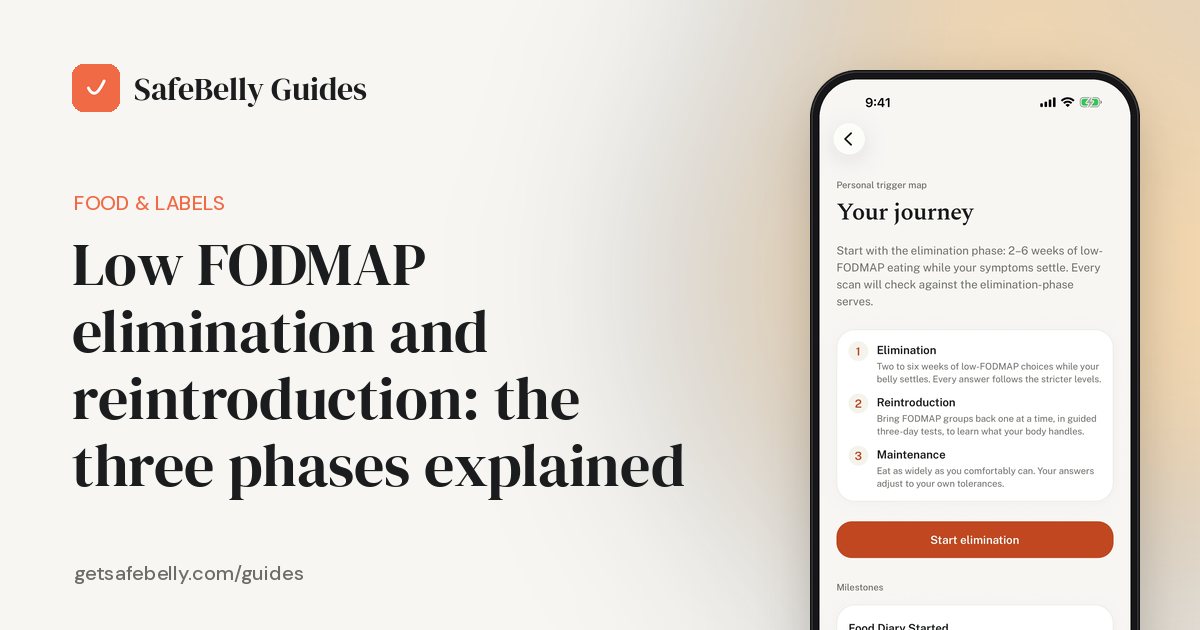
- Low FODMAP phase (about 2–6 weeks). Swap high FODMAP foods for lower FODMAP alternatives. Monash stresses this is substitution, not cutting out whole food groups: an orange instead of an apple, chives instead of onion.
- Reintroduction (about 6–8 weeks). Keeping your usual meals low FODMAP in the background, you test one FODMAP group at a time over a few days, in increasing amounts, and note how you feel.
- Personalization (long term). Bring back everything you tolerated, and limit only your own triggers, only as much as you need to. Tolerance can change, so it’s worth retesting foods later.
If your symptoms haven’t improved after the first phase, Monash suggests there’s no need to keep going; other therapies may help instead, such as stress management, gut-directed hypnotherapy or medicines your doctor recommends (Monash FODMAP).
We explain each stage in detail, including how a reintroduction challenge is structured, in low FODMAP phases explained.
Why work with a dietitian (and your doctor)?
Monash recommends following the approach with a dietitian who has specialist skills in IBS and FODMAPs, and keeps a directory of Monash FODMAP-trained dietitians (Monash FODMAP). The NIDDK notes your doctor may refer you to a dietitian to plan changes to what you eat (NIDDK).
There are good reasons for this beyond convenience:
- Nourishment. The 2024 *Nutrients* review notes that short-term restriction can lower intake of fiber, calcium, iron, vitamin D and some B vitamins, and links most shortfalls to restriction without proper guidance (Bertin et al., 2024).
- Gut bacteria. The same review notes low FODMAP eating tends to lower Bifidobacteria, which may return toward baseline once foods are reintroduced and personalized (Bertin et al., 2024).
- Sticking with it. In one case series summarized in that review, people supported by a dietitian kept going through all three phases far more often than those without one (Bertin et al., 2024).
- Your relationship with food. The review recommends screening for disordered eating before starting. If food already feels stressful, say so; a good dietitian will adapt the plan. Our guide to food anxiety and digestive conditions may help too.
A practical first week
Once you and your care team have agreed to start, a calm first week is mostly about preparation and swaps. Cleveland Clinic suggests setting aside time, preparing menus and keeping a few easy standby meals on hand (Cleveland Clinic).
- Start a food and symptom diary a few days early. A baseline makes changes easier to spot. See our food and symptom diary guide.
- Plan five or six simple meals you already like and adapt them: rice or potatoes instead of wheat-based sides, chives or garlic-infused oil instead of garlic and onion (the fructans in garlic and onion dissolve in water but not in oil, per Monash FODMAP), lactose-free milk or yogurt instead of regular.
- Shop with a short list. Plain cooked meats, eggs, firm tofu, carrots, cucumber, green beans, oranges, kiwifruit and oats are commonly listed as lower FODMAP choices (Monash FODMAP food list).
- Read labels for onion, garlic, honey, high-fructose corn syrup, inulin and sweeteners ending in “-ol”.
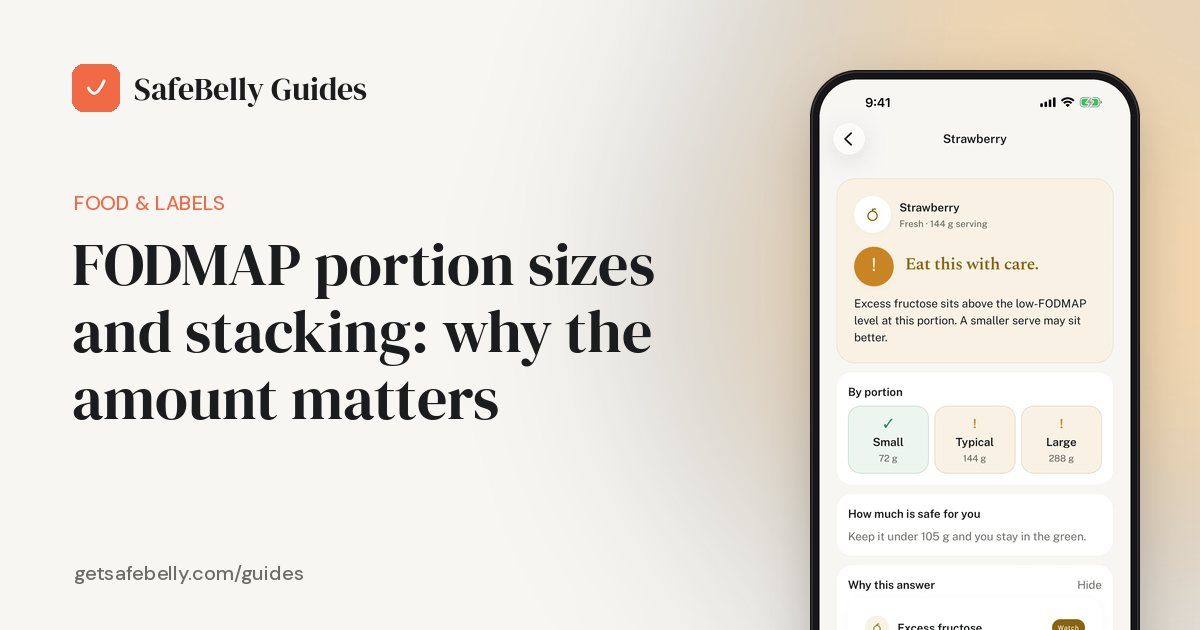
- Mind the portion. Many foods are lower FODMAP at a typical serving and higher at a larger one. Our guide to FODMAP portion sizes explains why.
- Space meals out. Monash suggests leaving two to three hours between meals and snacks (Monash FODMAP).
- Be kind to yourself about slips. Eating something higher in FODMAPs doesn’t undo your progress. Note it and carry on.
Keep meals varied and satisfying. The first phase is about swapping, not eating less. If you notice you’re cutting out more and more foods, talk to your dietitian.
Why this isn’t meant to be forever
The low FODMAP phase is short on purpose. Many FODMAP-containing foods are nourishing (certain vegetables, fruits, legumes and whole grains), and staying restricted long term narrows variety (Cleveland Clinic). Reintroduction is what turns a restrictive few weeks into a personalized, sustainable pattern.
If eating out is the hardest part for you, our guide to eating out with IBS has practical scripts and menu tips.
How SafeBelly helps
Know before you eat.
SafeBelly answers “Can I eat this?” for IBS using low-FODMAP scoring, and shows the answer at small, typical and large portions because dose matters. Its Guided Journey walks through elimination, reintroduction and maintenance alongside a meal diary and a one-tap “How’s your belly?” check-in you can export to share with your dietitian. It’s a food information app, not a medical device, and works best alongside professional care.
SafeBelly is in final testing on iPhone and Android. Leave your email and we'll send one note the day it's in the App Store and on Google Play.
Frequently asked questions
How long should I follow the low FODMAP diet for IBS?+
The strict low FODMAP phase usually lasts about 2–6 weeks, according to Monash University. It is followed by reintroduction (often around 6–8 weeks) and then a long-term personalized phase. If symptoms haven’t improved after the first phase, talk to your doctor or dietitian about other options.
Does the low FODMAP diet work for everyone with IBS?+
No. Monash reports that about three in four people with IBS see their symptoms improve, and about one in four do not. That’s one reason to try it with professional support, so you can move to other approaches if it isn’t helping.
Can I start a low FODMAP diet without a dietitian?+
Monash and gastroenterology guidance recommend working with a dietitian trained in FODMAPs. A dietitian helps you keep meals nourishing, structures reintroduction properly and keeps restriction to the shortest time needed. If access is difficult, ask your doctor about options.
Is gluten-free the same as low FODMAP?+
No. Wheat, rye and barley contain fructans, which is why many wheat-free products fit a low FODMAP pattern, but the issue for FODMAPs is the carbohydrate, not the gluten protein. Celiac disease needs a strict gluten-free approach for life and should be tested for before you change what you eat. See our guide to celiac disease and gluten-free eating.
Are garlic and onion high FODMAP?+
Yes. Garlic and onion are commonly listed as high in fructans. Monash suggests chives as an onion swap, and notes that fructans don’t dissolve into oil, which is why garlic-infused oil is used for flavor. They also hide in stocks, sauces and seasonings, so check labels.
What happens after the elimination phase?+
You move to reintroduction, testing one FODMAP group at a time while the rest of your meals stay low FODMAP. The results guide your long-term, personalized way of eating, where you limit only your own triggers.
Sources
- FODMAPs and Irritable Bowel Syndrome · Monash University FODMAP
- Starting the Low FODMAP Diet · Monash University FODMAP
- The 3 steps of the FODMAP diet · Monash University FODMAP
- Eating, Diet, & Nutrition for Irritable Bowel Syndrome · National Institute of Diabetes and Digestive and Kidney Diseases (NIDDK)
- ACG Clinical Guideline: Management of Irritable Bowel Syndrome (Lacy et al., 2021) · American Journal of Gastroenterology via PubMed
- Low-FODMAP Diet · Cleveland Clinic
- The Role of the FODMAP Diet in IBS (Bertin et al., 2024) · Nutrients via PubMed Central
- Cooking with onion and garlic · Monash University FODMAP
SafeBelly is a food information app, not a medical device, and no substitute for professional medical advice. Talk to your doctor or a registered dietitian before making changes to how you eat, and seek urgent care for severe or sudden symptoms.
Keep reading
Food & labels
Low FODMAP elimination and reintroduction: the three phases explained

Food & labels
High FODMAP foods list, with gentler swaps for each one
Food & labels
FODMAP portion sizes and stacking: why the amount matters

Food & labels
Hidden garlic and onion: foods that contain them and how to spot them