Key points
- FODMAPs are about dose: many foods are low FODMAP at a typical serving and higher at a larger one.
- Some foods stay low FODMAP even in large servings, so not every food has an upper limit.
- “Stacking” means FODMAPs from several foods in one meal can add up.
- Stacking applies to a single sitting, not your whole day; spacing meals helps.
- If your symptoms are settled, there’s no need to worry about stacking.
Does FODMAP portion size really matter?
Yes. FODMAP portion size matters because FODMAPs are a question of *how much*, not just *which food*. Many foods are low in FODMAPs at a typical serving but contain moderate or high amounts at a larger one. Monash University rates each food by serving size for exactly this reason, using green (low), amber (moderate) and red (high) (Monash FODMAP). And when you eat several foods together, the FODMAPs in them can add up, which is what people call FODMAP stacking (Monash FODMAP).
This is good news. It means a food that troubles you in a large serving may still be something you enjoy in a smaller one. Thinking in amounts, rather than in “allowed” and “banned” lists, keeps your eating wider and less stressful.
New to FODMAPs? Start with our beginner’s guide to the low FODMAP diet for IBS, then come back here.
Why dose matters in your gut
FODMAPs are short-chain carbohydrates that aren’t fully absorbed. Monash explains that they move slowly through the small intestine, drawing in water, and are then fermented by gut bacteria in the large intestine, producing gas. The water and gas stretch the bowel wall, and in people with IBS that stretch can be felt as pain, bloating or changes in bowel habit (Monash FODMAP).
More FODMAPs generally means more of that water and gas. So the same food can sit comfortably at one serving and cause symptoms at a bigger one. The NIDDK’s list of high FODMAP foods reflects this: alongside specific fruits, it lists large amounts of fruit juice or dried fruit (NIDDK).
Everyone’s threshold is different. Monash notes that each person’s tolerance for FODMAPs varies, and that many people get good symptom control with a varied mix of low FODMAP servings in each meal, while others are more sensitive (Monash FODMAP).
Why a food can be fine at one portion and not another
Monash’s research dietitians give some everyday examples of foods whose rating changes as the serving grows (Monash FODMAP):
| Food | At a typical serving | At a larger serving |
|---|---|---|
| Sweet potato | Low FODMAP | Moderate, then high, in mannitol (a polyol) |
| Red cabbage | Low FODMAP | Moderate, then high, in fructans |
| Eggplant | Low FODMAP | Moderate, then high, in sorbitol (a polyol) |
| Carrot | Low FODMAP | Stays low; no upper limit listed |
We’ve deliberately left out the exact cut-offs. Monash publishes serving-size thresholds in the Monash FODMAP app, where each food shows smaller traffic lights for different serving sizes (Monash FODMAP). Those figures come from laboratory testing and are best checked there, ideally with a dietitian.
Notice the last row. Many low FODMAP foods have no practical upper limit (Monash FODMAP). You don’t need to measure everything. Portion awareness matters most for foods that change rating as the serving grows.
Monash also gives a practical trick for foods with a limit: bulk the dish out with foods that don’t. A sweet potato soup, for instance, can be stretched with parsnip, potato and carrot (Monash FODMAP).
What is FODMAP stacking?
FODMAP stacking is the idea that when you eat several low FODMAP (“green”) servings of different foods in one sitting, the FODMAPs can accumulate in your gut and, for some people, trigger symptoms (Monash FODMAP).
Monash points out that “stacking” isn’t a term from the scientific literature, but the concept rests on research findings: several FODMAPs together tend to cause more symptoms than one alone, and restricting all FODMAPs helps more than restricting just one (Monash FODMAP).
- It’s the total that counts. Stacking can involve any mix of FODMAP types, not only the same one. Fructans from one food and polyols from another all add to the total.
- It’s per sitting. Stacking relates to a single meal or snack, not your whole day.
- It’s mostly about larger servings. Monash’s serving cut-offs are deliberately conservative, so a meal can usually include more than one green serving. Stacking matters most when moderate or high servings come into play.
All three points come from Monash’s explainer on stacking (Monash FODMAP).
How to think about portions without counting everything
Monash says there’s no need to track exact FODMAP amounts in each meal (Monash FODMAP). A few calm habits do most of the work:
- Space your meals and snacks. Monash suggests at least 2–3 hours between eating occasions so your gut isn’t exposed to FODMAPs continuously (Monash FODMAP).
- Notice the foods that change with portion. For foods with a serving limit, check the Monash app and enjoy them at a serving that suits you.
- Bulk out meals with foods that have no limit. Potato, carrot, cucumber, eggs, firm tofu and plain cooked meats are listed among lower FODMAP choices (Monash FODMAP food list).
- Keep a food and symptom diary. Writing down amounts, not just foods, helps you and your dietitian see whether portion or stacking is part of the picture. See our food and symptom diary guide.
- Don’t panic over one larger serving. Monash’s dietitians note that eating more than you planned once won’t undo your progress (Monash FODMAP).
If you snack often, Monash suggests pairing low FODMAP foods with some protein and fiber, and checking in with your hunger before you eat (Monash FODMAP).
When should you think about stacking?
In Monash’s words, “There is no need to worry about stacking if your symptoms are well controlled” (Monash FODMAP). If your symptoms continue while you’re eating low FODMAP, Monash suggests two possibilities: other factors such as stress or anxiety may be involved, or you may be particularly sensitive to FODMAPs and stacking is worth looking at, ideally with a GI dietitian experienced in the low FODMAP approach.
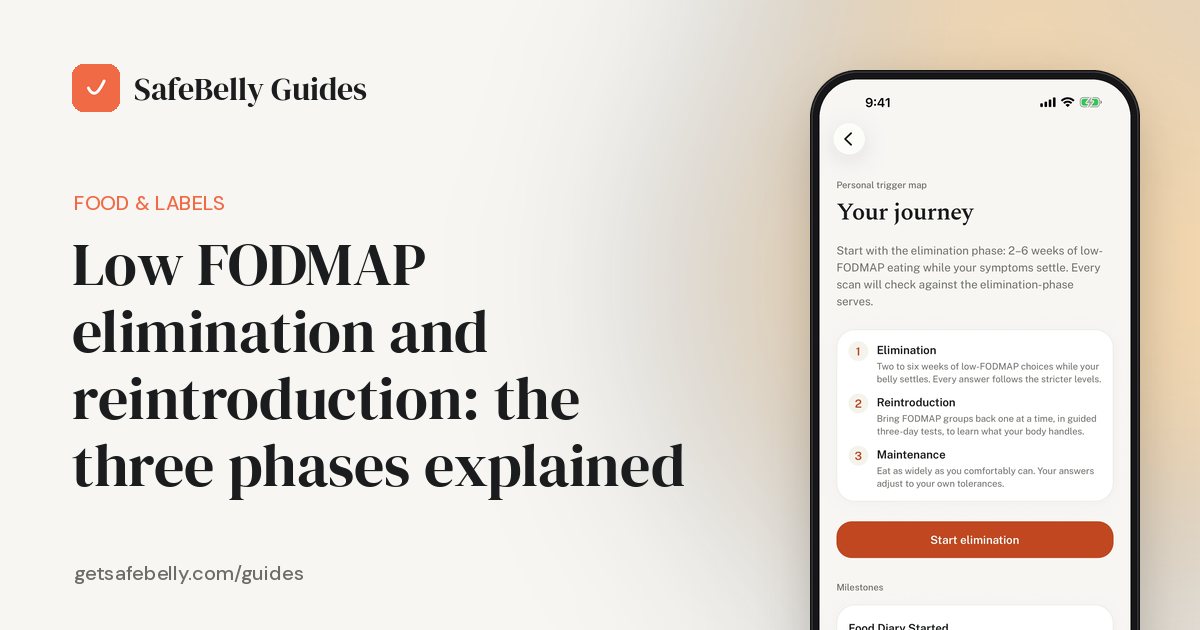
Portion size is also central to reintroduction. Each challenge moves from a moderate to a larger serving over a few days, which is how you find your personal threshold for each FODMAP group (Monash FODMAP). Our guide to low FODMAP phases explains how that works.
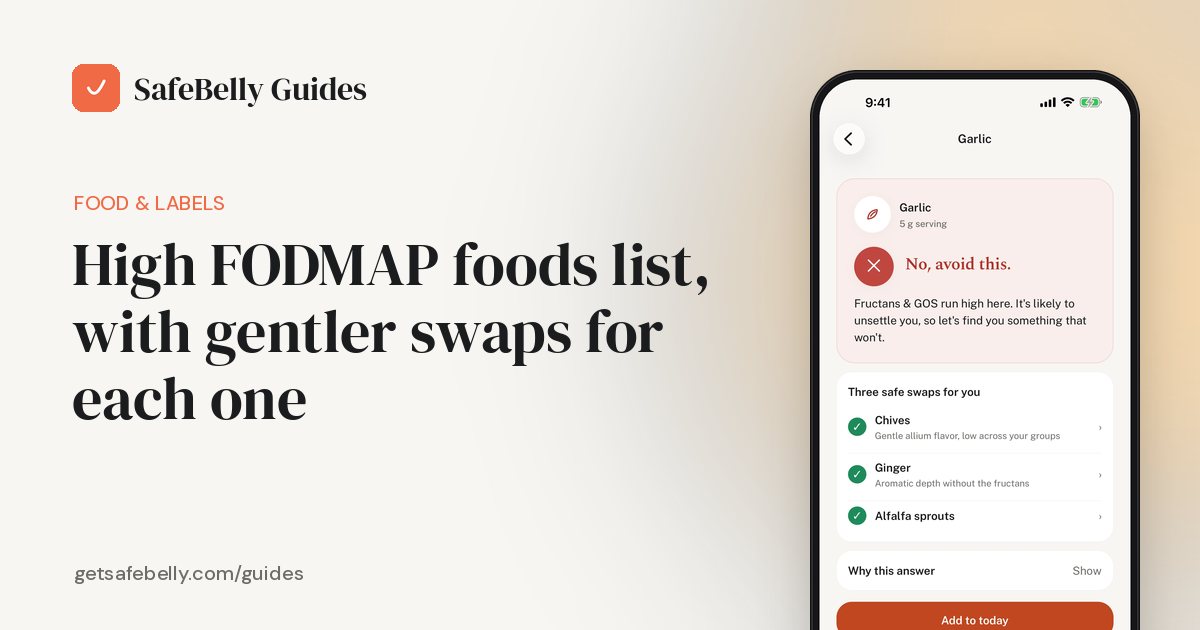
For a list of commonly high FODMAP foods and gentler swaps, see high FODMAP foods and swaps. If bloating is your main concern, our guide to bloating and food may help too.
How SafeBelly helps
Know before you eat.
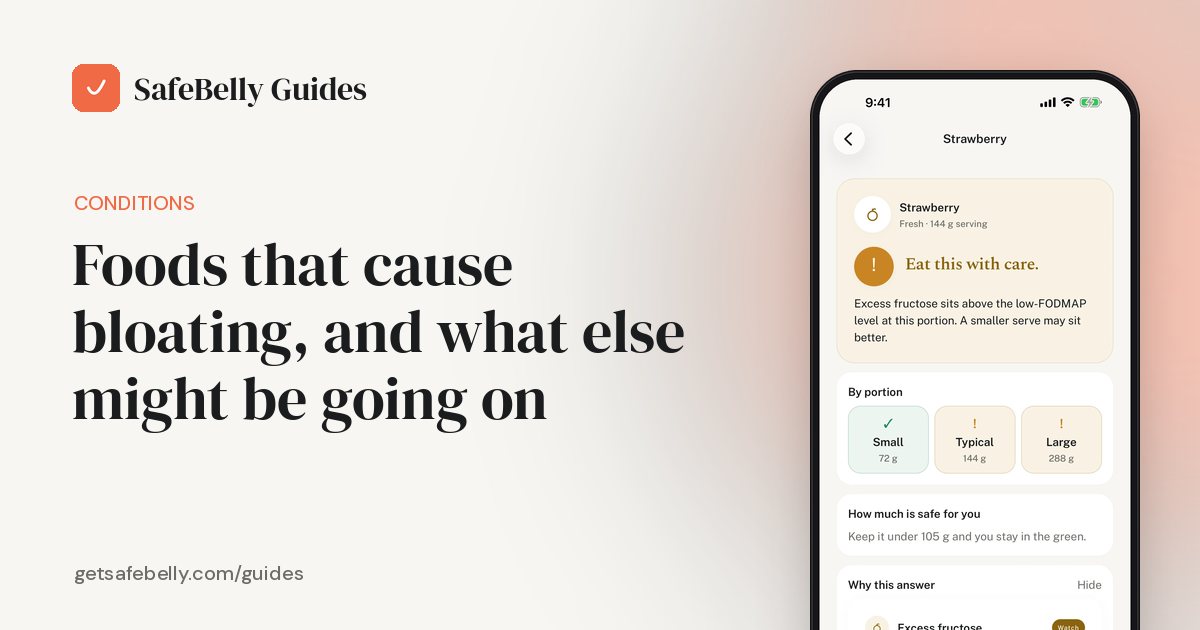
Because dose matters, SafeBelly shows its answer for FODMAP-based conditions at small, typical and large portions, so you can see when a food moves from “Yes, you can eat this.” to “Eat this with care.” Search a food, scan a barcode or photograph a plate to check. It’s a food information app, not a medical device, and your dietitian remains the best guide to your personal thresholds.
SafeBelly is in final testing on iPhone and Android. Leave your email and we'll send one note the day it's in the App Store and on Google Play.
Frequently asked questions
Are low FODMAP serving sizes per meal or per day?+
Monash describes stacking as relating to a single sitting or meal, not the whole day, assuming meals are spaced out. It suggests leaving at least 2–3 hours between meals and snacks.
Can I eat as much of a low FODMAP food as I want?+
For some foods, yes. Monash notes many low FODMAP foods, such as carrot, stay low even in large servings. Others, like sweet potato or red cabbage, become moderate or high at larger servings, so the Monash app lists a serving limit for them.
What is FODMAP stacking?+
It’s when several low FODMAP servings eaten in one sitting add up to enough FODMAPs to trigger symptoms in some people. The total can come from any mix of FODMAP types. Monash says there’s no need to worry about it if your symptoms are well controlled.
Do I need to weigh my food on a low FODMAP diet?+
Usually not. Monash says tracking exact FODMAP amounts isn’t necessary, and many foods have no upper limit. It can help to check serving sizes for the specific foods that change rating as portions grow.
Why did a food I tolerated before give me symptoms?+
It may have been a larger serving, or eaten alongside other FODMAP-containing foods in the same meal. Monash notes that factors like stress and anxiety can also play a part. A food and symptom diary with amounts can help you and your dietitian spot the pattern.
Sources
- FODMAP Stacking Explained · Monash University FODMAP
- FODMAP stacking: can I overeat 'green' foods? · Monash University FODMAP
- FODMAPs and Irritable Bowel Syndrome · Monash University FODMAP
- Starting the Low FODMAP Diet · Monash University FODMAP
- Practical tips for FODMAP Reintroduction · Monash University FODMAP
- FODMAP food list · Monash University FODMAP
- Eating, Diet, & Nutrition for Irritable Bowel Syndrome · National Institute of Diabetes and Digestive and Kidney Diseases (NIDDK)
SafeBelly is a food information app, not a medical device, and no substitute for professional medical advice. Talk to your doctor or a registered dietitian before making changes to how you eat, and seek urgent care for severe or sudden symptoms.