Key points
- Garlic and onion are both high in fructans, a FODMAP group that is a common trigger for people with IBS.
- They often hide in stocks, sauces, dressings, marinades, seasoning blends and restaurant base sauces.
- Under US FDA rules, garlic powder and onion powder must be named on the label, but "natural flavor" can still be hard to interpret.
- Garlic-infused oil can carry the flavor without the fructans, because fructans don’t dissolve in oil.
- Your tolerance is personal. A registered dietitian can help you test it rather than avoid both foods forever.
Why garlic and onion matter if you have IBS
Fructans are carbohydrates that the small intestine doesn’t fully digest. According to the NIDDK, bacteria in the large intestine break down carbohydrates that weren’t digested higher up, and this produces gas. For people with a sensitive gut, that can mean bloating, pain or changes in bowel habit.
Not everyone reacts to fructans, and people who do react may tolerate different amounts. That is why Monash describes the low-FODMAP approach in three steps: a short elimination phase, a challenge phase where FODMAP groups are tested one at a time, and a personalized long-term phase that relaxes restrictions as much as possible. Monash recommends doing this with a dietitian who has specialty skills in IBS.
Check with your doctor or a registered dietitian ahead of cutting out foods. Garlic and onion bring flavor and variety, and the aim is to find your own threshold, not to avoid them forever.
Reading US labels: "spices", "natural flavors" and powders
US food labeling rules help here, but they also leave some gaps. Under the FDA regulation on flavor labeling, 21 CFR 101.22:
- "Spice" excludes garlic and onion. The definition of spice leaves out substances traditionally regarded as foods, and names onions, garlic and celery as examples.
- Garlic powder and onion powder must be named. Powdered or granulated onion and garlic are treated as food rather than flavor, and must be declared by their common names.
- "Natural flavor" is broad. It can cover essential oils, essences or extractives from vegetables and other plant sources. The label doesn’t have to say which plant they come from.
In practice, that means "garlic powder", "onion powder", "dehydrated onion" or "garlic" should appear by name on FDA-regulated packaged foods. The harder cases are vague terms like natural flavor, flavoring and seasoning, which can’t tell you whether a garlic or onion extract is present. Meat and poultry products are regulated by the USDA rather than the FDA, so their labels can look a little different.
| Label wording | What it tells you | What to do |
|---|---|---|
| Garlic, onion, shallot, leek | The ingredient is present | Treat as a likely trigger if fructans bother you |
| Garlic powder, onion powder, dehydrated onion | Concentrated garlic or onion | Usually best avoided while you are in elimination |
| Spices | Under FDA rules, should not include garlic or onion | Lower concern, but still read the full list |
| Natural flavor, flavoring | Could include plant extracts; source not stated | Contact the manufacturer if you need to know |
| Seasoning, seasoning blend | Ingredients may be listed in brackets | Read the bracketed list closely |
Ingredients change. Read the label every time you buy, even on a product you know. If you also have a food allergy, our guide to reading food labels for allergens covers what US and EU/UK law requires.
Packaged foods worth checking
These are the aisles where garlic and onion most often turn up. It isn’t a list of foods to avoid, just the labels worth a second look:
- Stocks, broths and bouillon. Monash lists stock as a low-FODMAP option only when it is made without onions or garlic.
- Soups and ready meals, which usually start with a stock or an onion base.
- Pasta sauces, salsas and tomato-based sauces.
- Salad dressings and marinades. Registered dietitian Kate Scarlata notes that commercial salad dressings and marinades often contain garlic and onion.
- Seasoning mixes and rubs. Monash suggests steering clear of seasoning mixes and blends during elimination unless you can check every ingredient.
- Curry pastes, stir-fry sauces and gravy mixes.
- Dips and spreads, such as hummus, tzatziki and flavored cream cheese.
- Flavored crackers, chips and snacks, especially "sour cream and onion" or "garlic" varieties.
- Processed meats, such as sausages, burgers and deli meats.
Restaurant dishes where garlic and onion hide
Menus rarely list every ingredient, so restaurant food is where hidden garlic and onion catch people out most. Monash’s eating-out tips point to sauces, dips and dressings, rich dishes like curries, and stock-based dishes such as soups and risottos as the usual sources.
| Dish | Where it hides | What you can ask |
|---|---|---|
| Caesar salad | Classic Caesar dressing is made with garlic | Dressing on the side, or oil and vinegar instead |
| Grilled or roasted meat | Marinades and rubs | Plain grilled with salt, pepper and herbs |
| Pasta and pizza | Tomato passata; garlic and oil (bianco) bases | Is the sauce just tomato and salt? Can the garlic be left off? |
| Risotto and soups | The stock | Is the stock made with onion or garlic? |
| Curries | Curry pastes often contain shallots or onion | Call ahead to ask what can be adapted |
| Chinese stir-fries | Sauces; spring onion garnish | Which sauces contain onion or garlic? Green parts of spring onion only |
| Steak with sauce | Pan sauces and gravies | Mustard instead of the sauce |
Several of these suggestions come from Monash’s guide to Italian, Chinese, French and Indian dining. For a full plan, including what to say to staff, see eating out with IBS.
Garlic-infused oil: the flavor without the fructans
Here is the useful bit of food science: Monash explains that fructans dissolve in water but not in oil. When garlic or onion is warmed in oil, much of the flavor moves into the oil while the fructans stay in the solid pieces.
- At home: Monash’s method is to gently cook garlic pieces in oil for a minute or two, then discard the pieces and use the flavored oil.
- In stores: Products carrying the Monash University Low FODMAP Certified logo have been lab tested.
- Watch for pieces: An oil with chunks of garlic still in it, or a dish where garlic is cooked in and served, is not the same thing.
- Liquids carry fructans: Because fructans dissolve in water, a soup or stock simmered with onion keeps them even if the onion is strained out.
Homemade garlic-in-oil needs care. University of Minnesota Extension explains that garlic can carry botulism spores and that oil-based products like this need refrigeration for food safety. Make small batches, keep them in the fridge and don’t leave them out at room temperature.
Other ways to keep the flavor
Monash’s list of low-FODMAP flavor ideas includes several onion and garlic stand-ins:
- Chives, which give a mild onion note.
- Spring onion (scallion), green part only. Monash lists the green part, not the white bulb.
- Asafoetida (hing), a pinch only, for an onion-like savory flavor. Powdered asafoetida is usually a blend, so read the ingredients, especially if you also avoid gluten (see hidden sources of gluten).
- Ginger, fresh herbs and citrus, which brighten a dish without relying on alliums.
- Garlic-infused or onion-infused oil, as above.
Serving sizes matter for FODMAPs, and even low-FODMAP foods can add up across a meal. The Monash FODMAP app has the current tested amounts. Our guide to FODMAP portion sizes explains why dose matters.
Will I always have to avoid garlic and onion?
Not necessarily. The elimination phase of a low-FODMAP approach is meant to be short, and the challenge phase is there to find out what you actually tolerate. Tolerance varies from person to person, and the only way to know yours is to test it in a structured way.
- Work with a doctor or registered dietitian to confirm that a low-FODMAP approach is right for you.
- During elimination, focus on the hidden sources in this guide, not only whole garlic and onion.
- In the challenge phase, test fructans in a structured way, ideally with a dietitian’s plan.
- Keep a simple food and symptom diary so you can see your own patterns.
- Bring back what you tolerate, and keep checking labels for the foods that still bother you.
If your symptoms change, get worse, or come with unexplained weight change, bleeding or fever, talk to your doctor rather than adjusting your eating on your own.
How SafeBelly helps
Know before you eat.
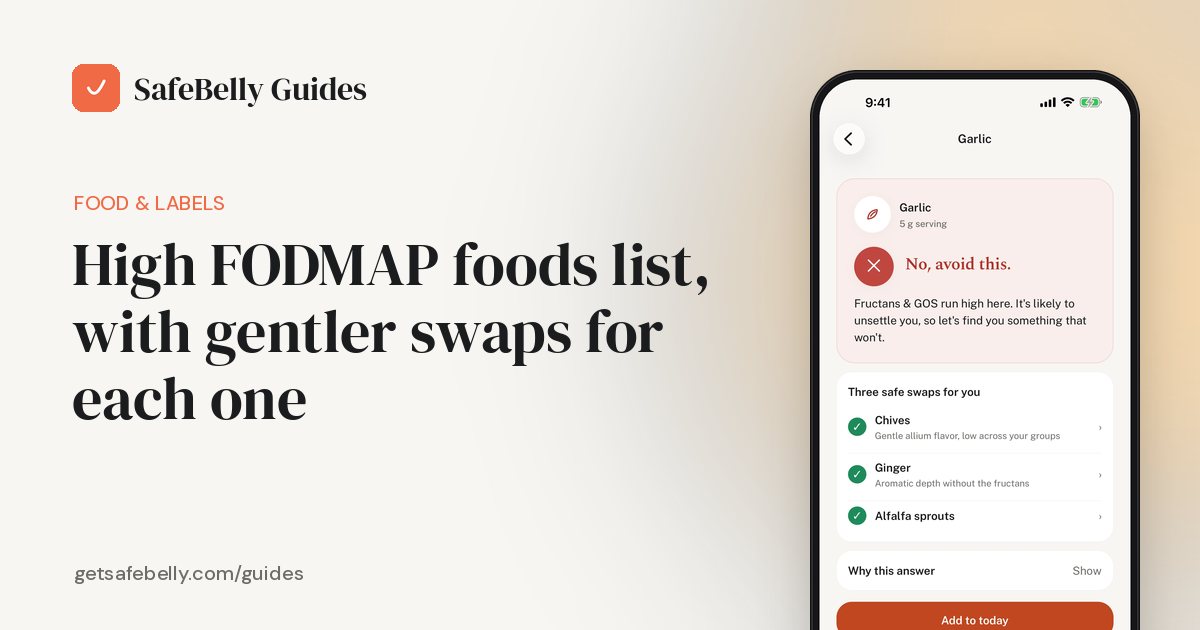
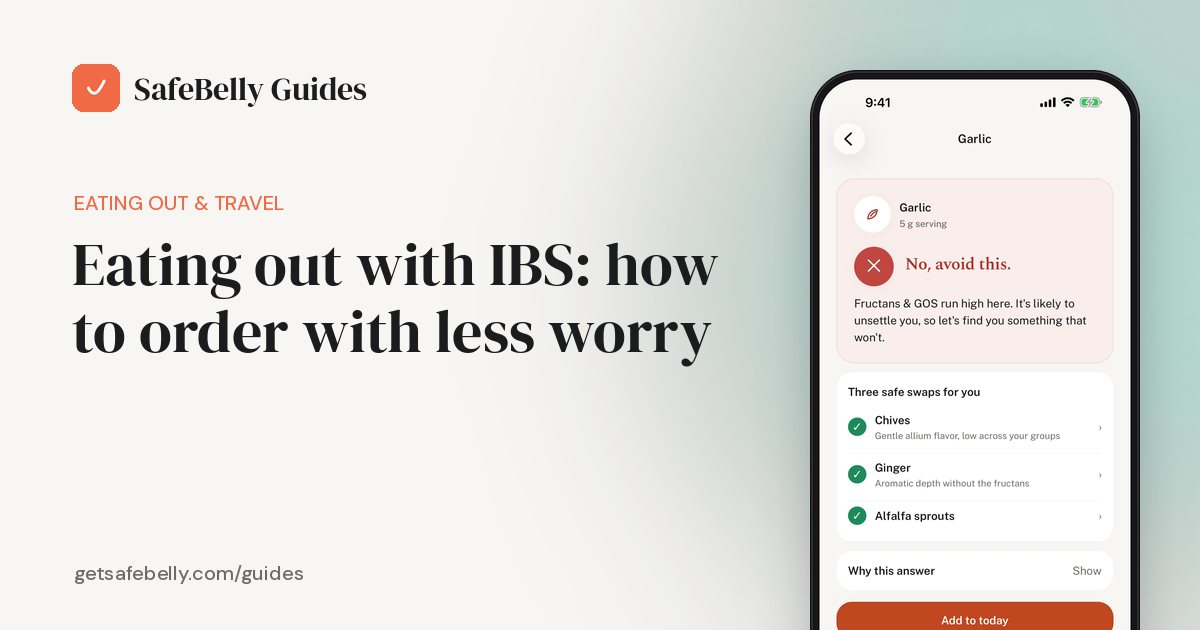
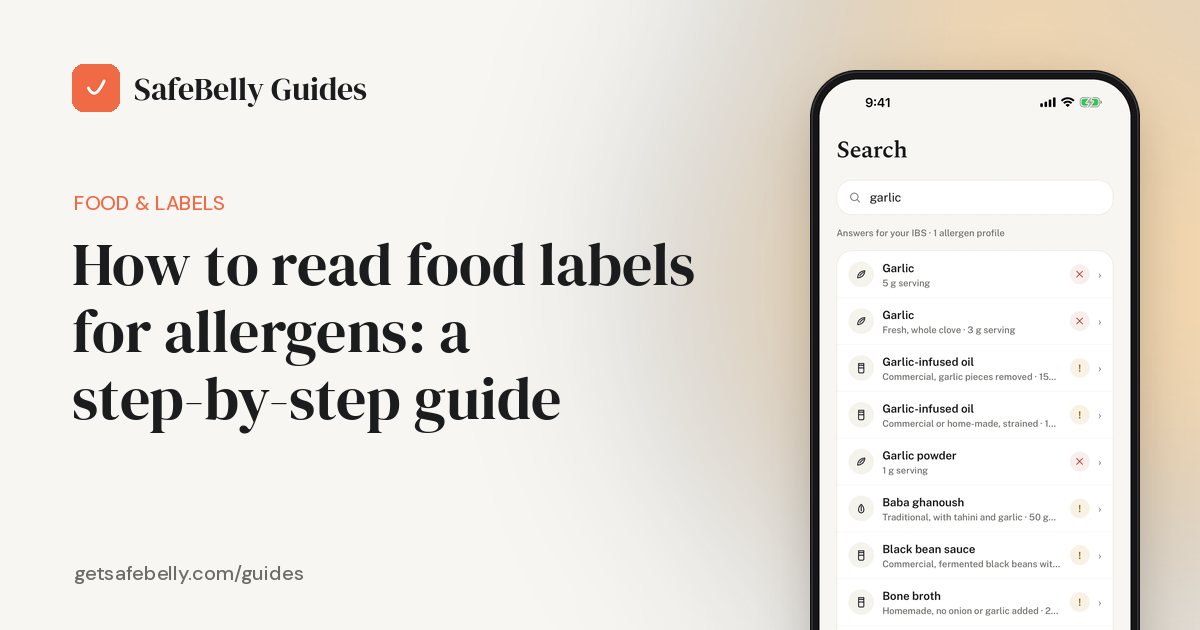
SafeBelly checks the ingredients of a food, a barcode or a photographed plate against the conditions you pick, so garlic and onion in a sauce or seasoning are flagged with the reason. For FODMAP-based conditions it shows the answer at small, typical and large portions, and when it can’t be sure, it leans to "Eat this with care" rather than "Yes". It’s a food information app, not a medical device, and it works alongside your dietitian’s advice.
SafeBelly is in final testing on iPhone and Android. Leave your email and we'll send one note the day it's in the App Store and on Google Play.
Frequently asked questions
Is garlic powder low FODMAP?+
No. Garlic powder is concentrated garlic, and Monash lists garlic as high in fructans. Garlic-infused oil is the usual way to keep garlic flavor during the elimination phase.
Can "natural flavors" contain garlic or onion?+
Possibly. Under FDA rules, garlic and onion powders must be named on the label, but "natural flavor" can include plant extracts without saying which plant. If you need to know, contact the manufacturer.
Does "spices" on a US label include garlic or onion?+
Under the FDA definition, garlic and onion are not counted as spices, because they are traditionally regarded as foods. They should be listed by name instead. Always read the full ingredient list, since products and formulas change.
Is garlic-infused oil safe for IBS?+
Monash explains that fructans don’t dissolve in oil, so a properly made infused oil carries the flavor without the fructans. Use oils without garlic pieces in them, or look for the Monash certified logo. Homemade garlic oil should be refrigerated for food safety.
Are spring onions and chives low FODMAP?+
Monash lists chives and the green part of spring onions as low-FODMAP flavor options. Leave out the white bulb, and check the Monash app for current serving sizes.
Is stock or broth safe if the onion has been strained out?+
Not usually. Fructans are water soluble, so they move into the liquid. Look for stocks made without garlic and onion, or make your own with infused oil and herbs.
Sources
- Cooking with onion and garlic · Monash University FODMAP
- Adding flavour without adding symptoms · Monash University FODMAP
- Starting the low FODMAP diet · Monash University FODMAP
- Eating out tips and tricks · Monash University FODMAP
- Eating out on a low FODMAP diet: Italian, Chinese, French and Indian · Monash University FODMAP
- 21 CFR 101.22: Foods; labeling of spices, flavorings, colorings and chemical preservatives · Legal Information Institute, Cornell Law School
- FODMAP friendly salad dressings · Kate Scarlata, RDN
- Minnesota cottage food law: Chili oil and oil-based products · University of Minnesota Extension
- Find certified low FODMAP foods · Monash University FODMAP
SafeBelly is a food information app, not a medical device, and no substitute for professional medical advice. Talk to your doctor or a registered dietitian before making changes to how you eat, and seek urgent care for severe or sudden symptoms.