Key points
- US labels must name each major allergen at least once, either in the ingredient list or in a “Contains” statement.
- Always read the full ingredient list: not every product has a “Contains” line, and allergens outside the US top 9 are not flagged.
- “May contain” warnings are voluntary in the US, so a missing warning does not mean a food is free of your allergen.
- In the EU and UK, the 14 allergens are emphasized inside the ingredient list, often in bold.
- Read the label every time you buy, even for familiar products, because ingredients and factories change.
How do you read a food label for allergens?
To read a food label for allergens, check three places every time: the ingredient list, any allergen names in parentheses, and the “Contains” statement, then look for voluntary “may contain” warnings. In the US, the law requires the food source of each major allergen to appear at least once, either inside the ingredient list (for example, “whey (milk)”) or in a “Contains” statement placed next to or after it, according to the FDA.
- Read the whole ingredient list, slowly, from start to finish.
- Look for allergen names in parentheses after less obvious ingredients, such as “albumin (egg)”.
- Read the “Contains” statement if there is one, but do not stop there.
- Look for “may contain” or “made in a facility” wording, and decide with your allergist how to treat it.
- If anything is unclear, put the product back or contact the manufacturer listed on the pack.
An FDA food technologist quoted in the agency’s consumer update Have Food Allergies? Read the Label puts it simply: if you see your allergen’s name even once, the product goes back on the shelf.
What the law requires on US labels
The Food Allergen Labeling and Consumer Protection Act (FALCPA) and the FASTER Act cover nine major allergens: milk, eggs, fish, crustacean shellfish, tree nuts, peanuts, wheat, soybeans and sesame. For a full overview of the list, see our guide to the major food allergens.
- Specific names for some groups. Tree nuts, fish and crustacean shellfish must name the type, such as almond, tuna or crab.
- Small amounts count. FARE notes that manufacturers must list a major allergen even in very small amounts.
- Sesame is newer. Sesame labeling has been required since January 1, 2023. Products made earlier may not list it, so the FDA suggests checking with the manufacturer.
- Milk and eggs from other animals. Since 2025 the FDA treats milk from goats, sheep and other ruminants, and eggs from ducks, quail and other fowl, as major allergens, and recommends naming the animal, such as “goat milk” or “duck egg”.
Some foods sit outside these rules. The FDA enforces FALCPA on the foods it regulates; most meat, poultry, certain egg products and most alcoholic drinks are overseen by other federal agencies. FARE adds that fresh foods such as meat, fruit and vegetables do not carry this labeling. For unpackaged foods like bakery items, the FDA advises asking store staff for allergen information.
Why the “Contains” statement is not enough
A “Contains” statement is useful, but it is optional. The FDA notes that not every product with an allergen carries one, because the manufacturer may instead put the allergen name in parentheses within the ingredient list. If you only scan for the “Contains” line, you can miss it.
It also only covers the US top 9. If you react to something else, such as mustard, celery or a mollusc, nothing on a US label is required to flag it. FARE warns that allergens outside the law can be hidden under general terms like “natural flavorings” or spices, and that molluscan shellfish such as oysters, clams and scallops do not have to be labeled as a major allergen.
Manufacturers are usually the best people to answer questions a label cannot. The FDA suggests contacting the manufacturer or distributor named on the pack if you are unsure whether a product contains an ingredient you react to, and not buying it until you know. FARE suggests asking about manufacturing practices as well as ingredients, since shared equipment is not something the ingredient list will show.
If your allergen is not one of the nine, contact the manufacturer about spices, flavorings and seasonings rather than guessing.
Other names your allergen can hide behind
Many ingredients come from an allergen without its name in them. The FDA gives the example of casein, sodium caseinate and whey: all milk proteins. US law means “milk” must still appear on the label at least once, but learning the common aliases helps you read faster and spot problems in products from places with different rules.
| Allergen | Ingredient names that can signal it |
|---|---|
| Milk | Casein, sodium caseinate, whey, curds, ghee, lactalbumin, buttermilk |
| Egg | Albumin, ovalbumin, lysozyme, meringue, surimi |
| Wheat | Semolina, farro, graham flour, spelt, malt, food starches |
| Soy | Miso, natto, shoyu, soya, tamari, tempeh, textured vegetable protein |
These examples come from the FDA and the Allergy & Asthma Network. When one of these names appears, check whether the label also names your allergen, and ask the manufacturer if it does not. This table is a starting point, not a complete list. Ask your allergist or a registered dietitian for a fuller list for your allergen. If you avoid milk, our guide to lactose-free vs dairy-free explains how those two claims differ.
What does “may contain” mean on a label?
Phrases such as “may contain” or “produced in a facility that also uses” are called precautionary or advisory labels. In the US they are voluntary. The FDA says they should only be used for unavoidable cross-contact, cannot replace good manufacturing practices, and must be truthful and not misleading.
- A “may contain” label means there may be a risk of cross-contact. It does not tell you how much, or how likely.
- No warning does not mean no risk. Some manufacturers simply do not use these labels.
- Claims like “peanut-free” or “egg-free” are not regulated in the same way, FARE notes, so a product may still be made where allergens are present.
- The FDA says a product should not claim to be free of an allergen while also warning it may contain it.
How to treat “may contain” is a personal decision that depends on your allergy and its severity. Talk it through with your allergist, and when in doubt, contact the manufacturer and ask how they handle your allergen on that line.
Reading labels in the EU and UK
If you travel or shop for imported European foods, the rules look different. Under Regulation (EU) No 1169/2011, the 14 allergens must be emphasized within the ingredient list using a typeset that clearly sets them apart, for example by font, style or background color. In practice you will usually see them in bold, so there is often no separate “Contains” line.
- Look for highlighted words inside the ingredient list rather than a statement below it.
- The EU and UK list covers 14 allergens, including celery, mustard, lupin, molluscs and sulphites, which are not on the US list.
- In the UK, food that is prepacked for direct sale, such as a boxed sandwich made on site, must show an ingredient list with the 14 allergens emphasized, per GOV.UK.
- Restaurants and takeaways in the UK must be able to tell you about the 14 allergens in their food. If you are allergic to something outside the 14, GOV.UK says you can ask the business whether its food contains it.
Imported foods and products without a clear label
Labeling rules vary by country, and FARE advises taking extra care with imported foods. An allergen list from another country may cover different foods, use different words, or appear only in another language.
- Do not buy a product that has no ingredient list, or one you cannot read.
- Learn how your allergen is written in the language of countries you buy from or visit.
- When you travel, our guide to traveling with food allergies and intolerances covers labels abroad.
If you have a reaction or find a label that seems wrong, the FDA suggests keeping the packaging, talking with your health care provider and considering contacting the manufacturer. You can also report it to the FDA with product details such as lot codes and photos.
Habits that make label reading easier
- Read every time. FARE and the FDA both stress that ingredients and manufacturing can change, even for foods you have eaten before.
- Check sub-ingredients. A sauce, seasoning or filling can bring an allergen into an otherwise simple food. Our guides to hidden gluten and hidden garlic and onion show how this works for intolerances too.
- Teach children early. FARE suggests children can start checking labels once they can read, with an adult’s help.
- Keep a note of products you have checked. A food and symptom diary helps, but still re-read the label each time.
Label reading is a skill, and it gets quicker with practice. Your allergist can help you decide how strict to be with precautionary labels and which aliases matter most for you.
How SafeBelly helps
Know before you eat.
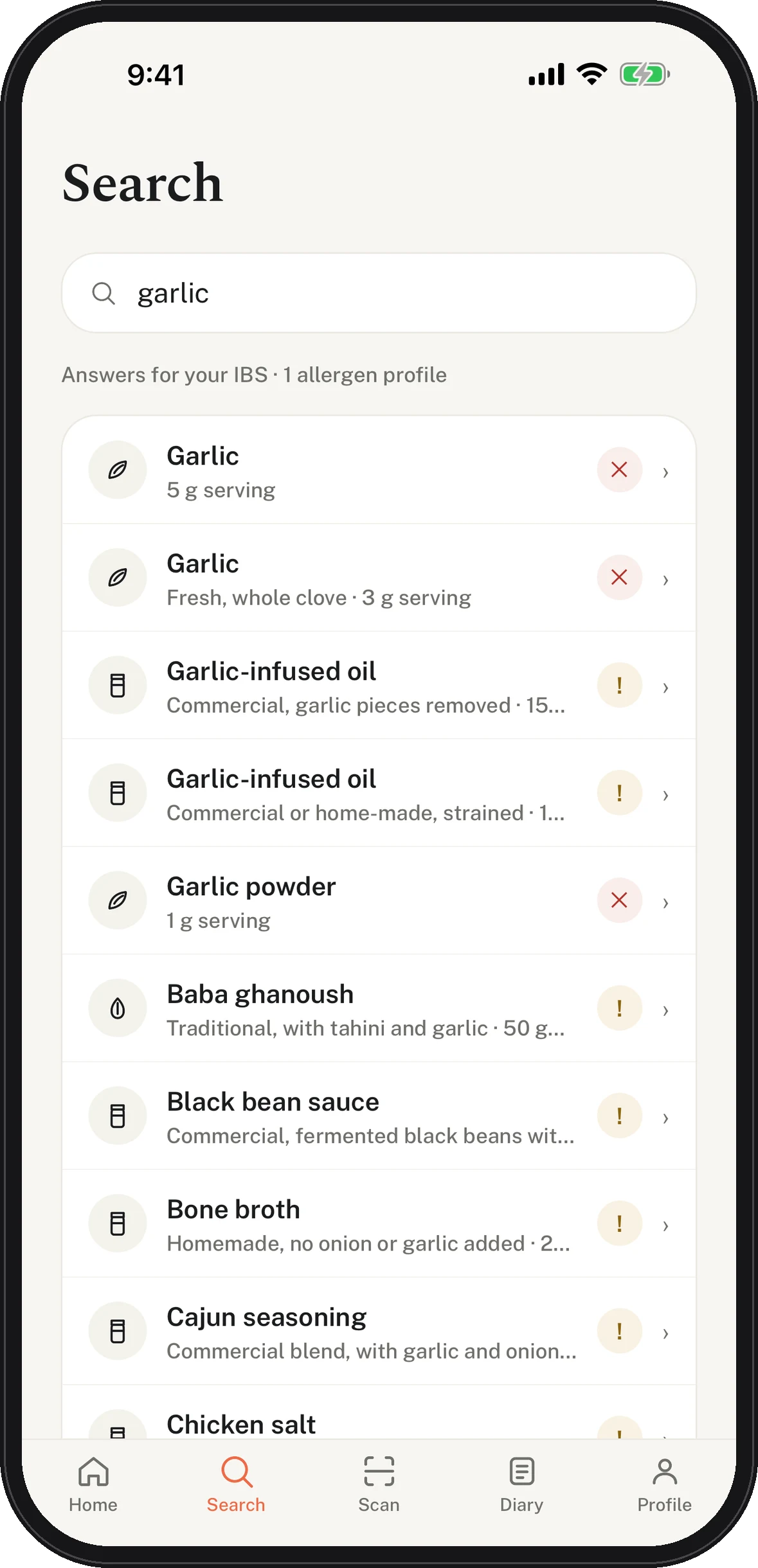
Scan a barcode in SafeBelly and it checks the product against the 14 major allergens and the conditions you have picked, then answers with “Yes, you can eat this.”, “Eat this with care.” or “No, avoid this.” and the reason why. It leans toward care or no when it cannot be sure. Please still read the label yourself, every time, because only the pack in your hand reflects today’s recipe.
SafeBelly is in final testing on iPhone and Android. Leave your email and we'll send one note the day it's in the App Store and on Google Play.
Frequently asked questions
Do all foods with allergens have a “Contains” statement?+
No. In the US, a manufacturer can name the allergen in parentheses inside the ingredient list instead, such as “whey (milk)”. That is why the FDA advises reading all ingredient information, not just the “Contains” line.
Is “may contain” labeling required by law in the US?+
No. “May contain” and “made in a facility” statements are voluntary. When used, the FDA says they must be truthful and not misleading, but many products carry no warning at all, so the absence of one does not mean a food is free of your allergen.
Are casein and whey dairy?+
Yes. Casein, sodium caseinate and whey are milk proteins. On US labels, “milk” must still appear at least once when they are used, either in parentheses or in a “Contains” statement.
Why are some ingredients in bold on European labels?+
EU and UK rules require the 14 major allergens to be emphasized within the ingredient list so they stand out. Bold is the most common way, though the law also allows other styles or background color.
Do I need to read the label if I have bought the product before?+
Yes. Recipes, suppliers and factories change without notice, so FARE and the FDA both recommend checking the label every time you buy.
Are imported foods labeled the same way?+
Not always. Each country sets its own allergen list and labeling style, so an imported product may not flag your allergen the way you expect. If there is no ingredient list you can read, it is safest not to buy it.
Sources
- Food Allergies · US Food and Drug Administration
- Have Food Allergies? Read the Label · US Food and Drug Administration
- Food Allergies: What You Need to Know · US Food and Drug Administration
- Frequently Asked Questions: Food Allergen Labeling Guidance for Industry · US Food and Drug Administration
- How to Read a Food Label · Food Allergy Research & Education (FARE)
- How to Read a Food Label for Food Allergies · Allergy & Asthma Network
- Regulation (EU) No 1169/2011, Article 21: Labelling of certain substances or products causing allergies or intolerances · legislation.gov.uk
- Eating out or ordering food when you have an allergy · GOV.UK
SafeBelly is a food information app, not a medical device, and no substitute for professional medical advice. Talk to your doctor or a registered dietitian before making changes to how you eat, and seek urgent care for severe or sudden symptoms.
Keep reading
Conditions
Major food allergens: the US top 9, the EU and UK 14, and how to stay prepared
Food & labels
Lactose-free vs dairy-free: what’s the difference and which do you need?
Food & labels
Hidden sources of gluten: where it hides and how to check

Eating out & travel
How to tell a restaurant about a food allergy (and what to ask)