Key points
- In the US, nine foods are major allergens: milk, eggs, fish, crustacean shellfish, tree nuts, peanuts, wheat, soybeans and sesame.
- The EU and UK name 14 allergens, adding celery, mustard, lupin, molluscs, sulphites and all cereals containing gluten.
- A food allergy involves the immune system and can be life-threatening; an intolerance is a digestive problem and is not an allergic reaction.
- Epinephrine is the first-line treatment for anaphylaxis. If it is prescribed, carry two doses and call emergency services after using it.
- Read the label every time you buy a food, because ingredients and factories can change without warning.
What are the major food allergens?
In the United States, the nine major food allergens are milk, eggs, fish, crustacean shellfish, tree nuts, peanuts, wheat, soybeans and sesame. Packaged foods regulated by the FDA must declare these by name on the label. The first eight were set by the Food Allergen Labeling and Consumer Protection Act of 2004 (FALCPA), and sesame was added as the ninth by the FASTER Act, signed on April 23, 2021 and in force from January 1, 2023, according to the FDA.
These nine are not the only foods that can cause reactions. The FDA notes that more than 160 foods have been identified as allergens, but when FALCPA passed, the original eight accounted for about 90% of food allergies and serious reactions. The American College of Allergy, Asthma and Immunology reports that almost 6% of US adults and children have a food allergy, and FARE puts the number of Americans affected by food allergy at 33 million.
| Allergen (US) | What to know |
|---|---|
| Milk | About 2.5% of children under 3 are allergic, per FARE. Since 2025 the FDA counts milk from goats, sheep and other ruminants, not just cows. |
| Eggs | One of the most common childhood allergies; many children outgrow it. FDA now counts eggs from ducks, geese, quail and other fowl as well as chickens. |
| Peanuts | A legume, not a tree nut, though some people react to both. |
| Tree nuts | Must be named by type on labels (almond, walnut, cashew and so on). Coconut is no longer on the FDA tree nut list for “Contains” statements. |
| Fish | Usually lifelong. FARE reports about 40% of people have their first reaction as adults. |
| Crustacean shellfish | Shrimp, crab, lobster. Usually lifelong; about 60% have their first reaction as adults, per FARE. |
| Wheat | Most common in children; FARE says two-thirds outgrow it by age 12. Different from celiac disease. |
| Soybeans | More common in babies and children. |
| Sesame | Labeled since January 1, 2023. Older stock may still lack a sesame declaration. |
Products made before 2023 could stay on shelves without sesame labeling. The FDA suggests contacting the manufacturer if you are unsure whether an older product contains sesame.
The EU and UK list of 14 allergens
If you shop or eat in the UK or the European Union, the legal list is longer. Annex II of Regulation (EU) No 1169/2011 names 14 allergens, and UK guidance on GOV.UK lists the same 14 for restaurants and takeaways:
- Celery
- Cereals containing gluten (such as wheat, rye, barley and oats)
- Crustaceans (such as prawns, crabs and lobsters)
- Eggs
- Fish
- Lupin (including lupin seeds and lupin flour)
- Milk
- Molluscs (such as mussels and oysters)
- Mustard
- Tree nuts (such as almonds, hazelnuts and walnuts)
- Peanuts
- Sesame
- Soybeans
- Sulphur dioxide and sulphites (above ten parts per million)
The overlap with the US list is large, but there are gaps worth knowing. Celery, mustard, lupin, molluscs and sulphites are not US major allergens, and wheat is the only grain named on the US list. FARE points out that molluscs such as oysters, clams and scallops do not have to be labeled as a major allergen in the US, and that allergens outside the law, such as mustard, can sit inside terms like “natural flavorings.”
If your allergen is not on the list where you live, you cannot rely on the “Contains” line to warn you. Read the full ingredient list, and contact the manufacturer when a vague term such as “spices” or “flavorings” leaves you unsure.
Food allergy vs food intolerance: what is the difference?
A food allergy is the immune system overreacting to a food, and it can range from mild to life-threatening. A food intolerance is trouble digesting a food. The NHS explains that an intolerance does not involve the immune system, is not usually serious and cannot cause a serious allergic reaction, though it can still make you feel very unwell.
| Food allergy | Food intolerance | |
|---|---|---|
| What is involved | The immune system | Digestion, not the immune system |
| Typical timing | Usually minutes to a few hours | Usually a few hours after eating |
| Common signs | Hives, swelling, wheezing, vomiting, dizziness | Bloating, wind, stomach pain, diarrhea |
| Can it be life-threatening? | Yes (anaphylaxis) | No allergic reaction, though symptoms can be distressing |
| Common examples | Peanut, tree nut, shellfish, milk, egg | Lactose, histamine, sulphites, caffeine |
The language can get blurry. A milk allergy and lactose intolerance are different things, and so are a wheat allergy and celiac disease. ACAAI notes that “gluten allergy” is a misleading term that is often confused with wheat allergy or celiac disease. If you are not sure which you are dealing with, an allergist or your doctor can help you find out. The NHS advises against home intolerance test kits and against cutting out foods without advice from a doctor or dietitian.
Two more terms you may hear: cross-reactivity, where someone allergic to one food also reacts to a related one (shrimp and crab, for example), and oral allergy syndrome, an itchy mouth from some raw fruits and vegetables that ACAAI describes as a pollen allergy rather than a food allergy. Your allergist can tell you which related foods matter for you.
What does an allergic reaction look like?
According to the FDA, symptoms usually appear within minutes to a few hours of eating the food and can vary between people and between reactions. They can include:
- Hives, flushed skin or a rash
- Tingling or itching in the mouth
- Swelling of the face, lips, tongue or throat
- Vomiting, diarrhea or stomach cramps
- Coughing, wheezing or trouble breathing
- Dizziness, lightheadedness or loss of consciousness
Anaphylaxis is a severe, whole-body reaction that can narrow the airways and drop blood pressure. The FDA stresses that it can start with mild symptoms and become life-threatening quickly, so a mild reaction does not mean the allergy is mild. The NHS lists warning signs that need emergency help, including a swollen throat or tongue, fast or difficult breathing, skin or lips turning blue, gray or pale, sudden confusion or drowsiness, and fainting.
Your emergency plan: what to do in a reaction
ACAAI calls epinephrine the first-line treatment for anaphylaxis and the only medication that can reverse its life-threatening symptoms. Because a second dose is needed in about 20% of cases, it advises keeping two doses on hand. FARE and the NHS give the same advice: if epinephrine is prescribed, carry two at all times.
- Stop eating the food straight away.
- If you have prescribed epinephrine and the signs point to a severe reaction, use it right away, following your own plan from your allergist.
- Call 911 (or your local emergency number). The NHS advises calling even if the person seems to be getting better after epinephrine.
- Tell the dispatcher epinephrine was given and that more may be needed, as ACAAI advises.
- Use the second dose if your plan says to and symptoms continue or return.
- Go to the emergency room, even if symptoms ease.
FARE publishes a free, physician-signed Food Allergy & Anaphylaxis Emergency Care Plan that lists your treatment steps and emergency contacts. Ask your doctor to fill it in, keep it with your medication, and share copies with family, school staff and anyone who regularly feeds you or your child.
Check expiry dates on your auto-injectors, and make sure the people you spend time with know where they are kept and how to use them.
How to spot allergens on food labels
Under US law, the food source of each major allergen must appear on the label at least once: inside the ingredient list (for example, “whey (milk)”) or in a “Contains” statement next to it. Tree nuts, fish and shellfish must name the specific type. “May contain” warnings are voluntary in the US, so their absence tells you nothing for certain.
- Read the full ingredient list, not just the “Contains” line.
- Read it every time, even for products you buy weekly, because recipes and factories change.
- Learn the less obvious names for your allergen, such as casein and whey for milk.
- Skip products with no ingredient list, and ask staff about unpackaged foods like bakery items.
We go through each part of the label, plus EU rules and imported foods, in how to read food labels for allergens.
Living with a food allergy day to day
Much of the risk sits in cross-contact, when tiny amounts of an allergen get into a safe food through shared utensils, surfaces or oil. FARE is clear that cooking does not remove an allergen, and that soap and water or commercial wipes remove allergens from hands, while sanitizing gel or water alone do not.
- Eating out: tell staff before you order, bring a chef card, and be ready to leave. See how to tell a restaurant about a food allergy.
- Travel: pack medication in your carry-on and bring safe snacks. See traveling with food allergies and intolerances.
- Tracking: a food and symptom diary can help you and your allergist spot patterns.
- Feelings: worry around food is common and understandable. Our guide to food anxiety has gentle ideas.
None of this replaces care from an allergist. Testing and diagnosis, what to avoid and how strictly, and your emergency plan are all decisions to make with them.
How SafeBelly helps
Know before you eat.
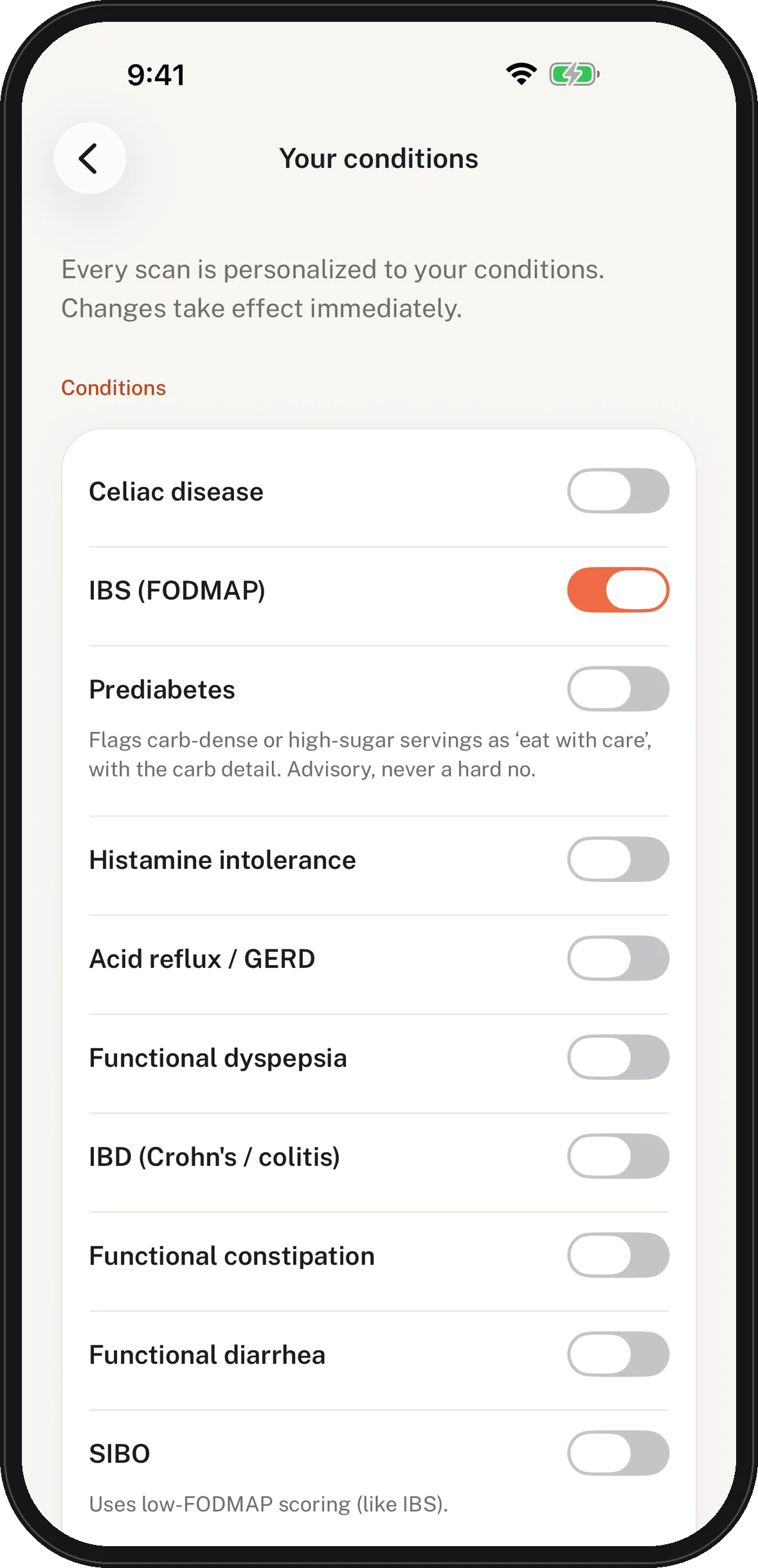
SafeBelly checks every food against the 14 major allergens on every check, whatever conditions you have picked. When it cannot be sure, it leans toward “Eat this with care” or “No, avoid this”, never “Yes”. It is a helpful second look, not a replacement for reading the label, asking staff and carrying your prescribed medication.
SafeBelly is in final testing on iPhone and Android. Leave your email and we'll send one note the day it's in the App Store and on Google Play.
Frequently asked questions
What are the 9 major food allergens in the US?+
Milk, eggs, fish, crustacean shellfish, tree nuts, peanuts, wheat, soybeans and sesame. Sesame became the ninth on January 1, 2023 under the FASTER Act. FDA-regulated packaged foods must declare these on the label.
What are the 14 allergens in the UK and EU?+
Celery, cereals containing gluten, crustaceans, eggs, fish, lupin, milk, molluscs, mustard, tree nuts, peanuts, sesame, soybeans, and sulphur dioxide or sulphites. Restaurants and takeaways must be able to tell you whether a dish contains any of them.
Is a food intolerance the same as a food allergy?+
No. An allergy involves the immune system and can cause a severe reaction. An intolerance is a digestive problem that does not involve the immune system and cannot cause an allergic reaction, though symptoms such as bloating and stomach pain can be very unpleasant. A doctor or allergist can help you work out which one you have.
Can you develop a food allergy as an adult?+
Yes. FARE reports that about 60% of people with a shellfish allergy and about 40% with a fish allergy have their first reaction as adults. If you notice new symptoms after eating, talk to your doctor.
Why do I need to carry two epinephrine auto-injectors?+
ACAAI reports that a second dose is needed in about 20% of anaphylaxis cases. FARE and the NHS both advise carrying two at all times if they are prescribed. After using one, call emergency services even if you feel better.
Does “may contain” mean a food is unsafe?+
It means there may be a risk of cross-contact. In the US these warnings are voluntary, so a missing warning does not mean a food is free of your allergen. Talk with your allergist about how to treat these labels for your own allergy.
Sources
- Food Allergies · US Food and Drug Administration
- Food Allergies: What You Need to Know · US Food and Drug Administration
- Frequently Asked Questions: Food Allergen Labeling Guidance for Industry · US Food and Drug Administration
- Common Allergens · Food Allergy Research & Education (FARE)
- Food Allergy · American College of Allergy, Asthma and Immunology
- Food allergy · NHS
- Food intolerance · NHS
- Eating out or ordering food when you have an allergy: Allergens businesses must tell you about · GOV.UK
SafeBelly is a food information app, not a medical device, and no substitute for professional medical advice. Talk to your doctor or a registered dietitian before making changes to how you eat, and seek urgent care for severe or sudden symptoms.
Keep reading
Food & labels
How to read food labels for allergens: a step-by-step guide

Eating out & travel
How to tell a restaurant about a food allergy (and what to ask)
Eating out & travel
Traveling with food allergies and intolerances: a planning guide
Food & labels
Lactose-free vs dairy-free: what’s the difference and which do you need?