Key points
- On US packaged food, "gluten-free" is a defined claim: less than 20 ppm of gluten.
- "Celiac-safe" is not a regulated term. Whether food suits someone with celiac disease also depends on how it was prepared.
- Certified gluten-free logos add independent checks. GFCO, for example, uses 10 ppm or the local limit, whichever is lower.
- "May contain" and "made in a facility" statements are voluntary in the US, so their absence doesn’t prove anything.
- Restaurant gluten-free dishes, and anything from a shared fryer, need questions, not assumptions.
Gluten-free vs celiac-safe: the short answer
"Gluten-free" on a US packaged food is a legal claim: the food must contain less than 20 parts per million (ppm) of gluten and meet the FDA’s other conditions (FDA). "Celiac-safe" has no legal definition. People usually use it to mean the food was also prepared in a way that avoids gluten cross-contact, such as a dedicated fryer, a fresh pot of water and separate surfaces. A dish can be made from gluten-free ingredients and still pick up gluten in the kitchen.
That gap matters most for people with celiac disease, where the approach is strict, lifelong gluten avoidance. If you are new to it, start with our celiac disease and gluten-free eating guide. This guide is general information, so please check specifics with your doctor or a registered dietitian.
What the US gluten-free label rule covers
The FDA rule applies to packaged foods it regulates. Under it, a food labeled gluten-free must be either naturally gluten-free, or contain no wheat, rye, barley or crossbreeds of these grains (such as triticale), and no ingredient made from them unless that ingredient has been processed to remove gluten. In every case, any unavoidable gluten must be under 20 ppm.
- Why 20 ppm: the FDA says methods to reliably detect gluten below that level weren’t validated when the rule was written, and some research suggests most people with celiac disease can tolerate trace amounts.
- Voluntary: a food can meet the definition without carrying the claim.
- Testing: manufacturers aren’t required to test, but they are responsible for making sure any product with the claim meets the rule.
- Malt: malt extract, malt syrup and malt vinegar made from barley can’t be used in gluten-free foods.
- Soy sauce: soy sauce made with wheat can’t carry the claim unless the wheat was processed to remove gluten ahead of fermentation.
- Fermented and hydrolyzed foods: because standard tests don’t reliably measure gluten in these, makers must keep records showing the food was under 20 ppm going into fermentation or hydrolysis.
What it doesn’t cover: the rule doesn’t apply to foods whose labels are regulated by the USDA, such as meat, poultry and certain egg products, or to most alcoholic drinks regulated by the TTB. For restaurants, the FDA recommends that gluten-free menu claims follow the same definition, and it shares complaints about unpackaged foods with state and local partners.
In the UK and EU, cereals containing gluten are one of the 14 allergens that must be emphasized in the ingredient list (Coeliac UK). In the US, wheat is one of the nine major allergens that must be declared, but barley and rye are not (FDA). Our hidden sources of gluten guide shows where barley tends to hide.
What does certified gluten-free mean?
Third-party certification is an extra layer on top of the legal rule. The FDA allows certification logos as long as they are truthful and not misleading, but it does not endorse any certification program.
Standards differ by program. The Gluten-Free Certification Organization (GFCO) requires products to meet the gluten-free threshold of the country of sale or 10 ppm, whichever is lower, and says both starting ingredients and finished products must test under that threshold.
| Label | What it tells you | What it doesn’t |
|---|---|---|
| "Gluten-free" (US packaged food) | Meets the FDA definition, under 20 ppm | That the maker tested it, or how strict their process is |
| Certified gluten-free logo | An independent program set a standard and checks against it | The same thing across programs; standards vary |
| "Wheat-free" | No wheat ingredient | Anything about barley, rye or malt |
| No gluten claim at all | Nothing either way | Whether the food contains gluten. Read the ingredients |
| "Gluten-free" on a menu | The restaurant intends the dish to be gluten-free | How it was prepared. Ask |
For foods that are often contaminated, such as oats and flours, a gluten-free label is especially worth looking for. Coeliac UK notes that naturally gluten-free flours can be milled where wheat flour is milled.
"May contain" and "made in a facility" statements
In the US, statements such as "may contain" or "produced in a facility that also uses wheat" are voluntary and not required by law (FDA). They are meant for unavoidable cross-contact, not as a replacement for good manufacturing practices.
- A statement plus a gluten-free claim: the FDA allows advisory statements on gluten-free foods if they are truthful and not misleading. The product must still meet the under-20 ppm rule.
- A statement and no gluten-free claim: you can’t know how much gluten might be present. Coeliac UK advises not eating products without a gluten-free claim that carry a "may contain" warning for gluten cereals.
- No statement at all: this does not mean there is no risk. Because the statements are voluntary, one company may label a shared line and another may not.
If a product matters to you and the label leaves you unsure, contact the manufacturer. Ask how they handle gluten on their production lines. Our guide to reading food labels for allergens covers advisory labels across all the major allergens.
Cross-contact: where gluten-free food picks up gluten
Cross-contact happens when gluten-free foods touch gluten-containing foods or the surfaces, utensils and water they were prepared with. The NIDDK notes it can happen during growing, processing, storage, preparation or serving.
Shared fryers are one of the clearest examples. In a small 2021 pilot study, researchers bought 20 orders of plain fries from restaurants that confirmed their fryers were also used for wheat-containing foods. One test method found gluten in 9 of the 20 orders, and the authors counted 5 of 20 as over 20 ppm (Frontiers in Nutrition). They concluded it remains prudent for people with celiac disease to avoid foods cooked in shared fryers.
- Fries and other fried foods: naturally gluten-free potatoes can pick up gluten from oil shared with breaded or battered foods.
- Pasta water: gluten-free pasta needs its own pot of fresh water, not water already used for wheat pasta.
- Grills and griddles: shared with buns, pancakes or breaded items.
- Toppings and garnishes: croutons, fried onions or a cookie on the side.
Oats: a clear example of the gap
Oats show the difference between "naturally gluten-free" and "suitable for celiac disease" better than almost any other food. Oats themselves don’t contain gluten, but the NIDDK notes that cross-contact between oats and gluten grains is common, and advises people with celiac disease to eat only oats labeled gluten-free.
- Regular oats: naturally gluten-free as a grain, but often grown and processed alongside wheat, barley and rye.
- Oats labeled gluten-free: in the US they must meet the same under-20 ppm rule as other gluten-free foods. The FDA says they don’t have to be certified to carry the claim.
- Certified gluten-free oats: meet the certifier’s standard as well, which may be stricter.
Even with gluten-free oats, the NIDDK suggests asking your doctor or dietitian how much oat is appropriate for you. The same logic applies to flours, grains and seeds: naturally gluten-free is the starting point, and the label tells you whether contamination has been managed.
Putting it together when you shop
- Read the full ingredient list every time. Recipes and factories change.
- Look for wheat, barley, rye, triticale, malt and brewer’s yeast, not just the "Contains" line.
- Prefer a gluten-free claim for higher-risk foods: oats, flours, sauces, seasonings and snacks.
- If there’s a "may contain" statement for gluten and no gluten-free claim, skip it or ask the maker.
- For anything you’re still unsure about, check with the manufacturer, your dietitian or both.
None of this needs to be perfect on day one. Most people build a short list of trusted brands and get quicker over time.
How SafeBelly helps
Know before you eat.
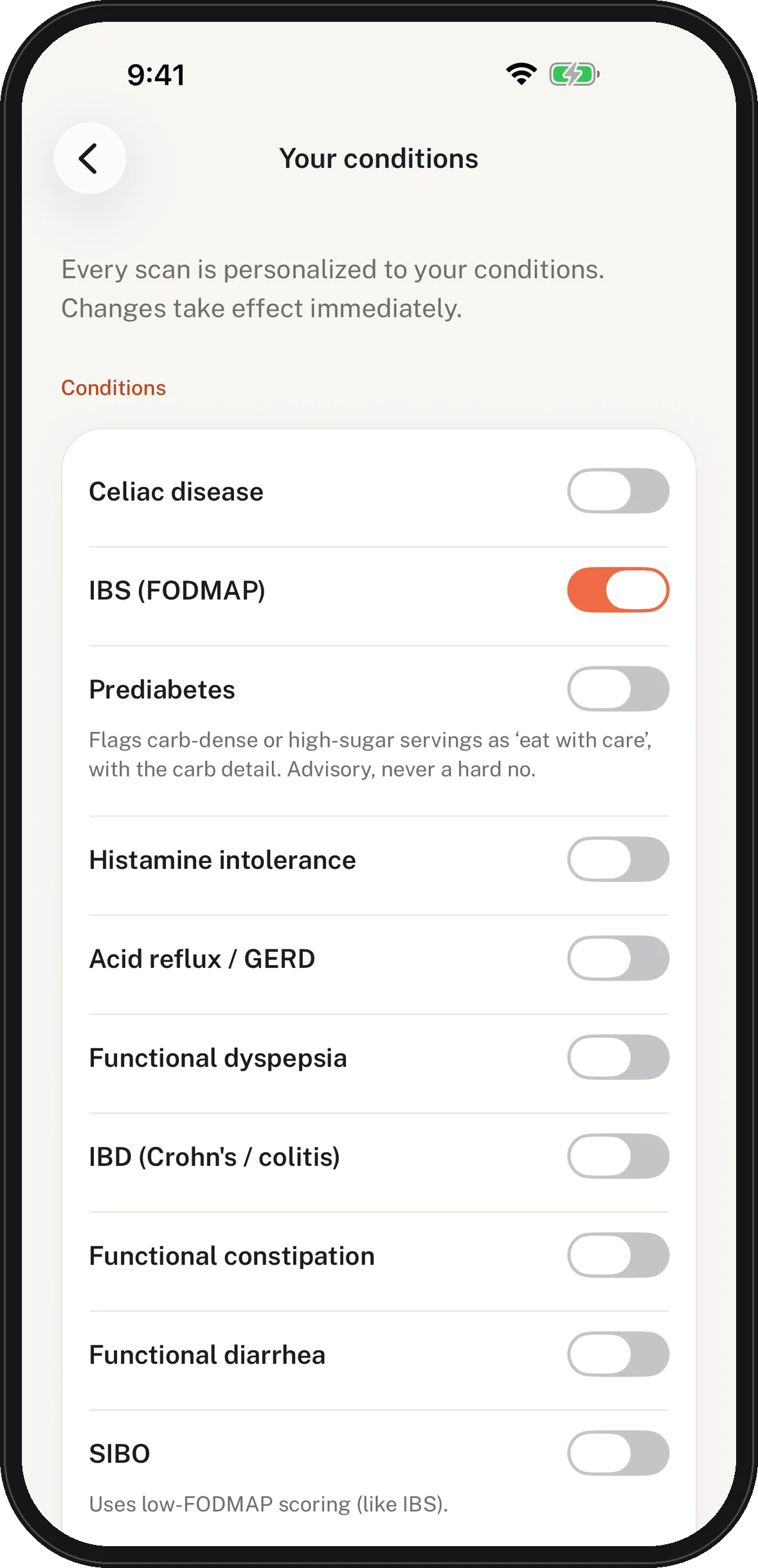
SafeBelly reads the ingredients behind a barcode or a food search and checks them for gluten sources when you choose celiac, along with the major allergens. If a product has a precautionary warning or the information is unclear, it leans to "Eat this with care." or "No, avoid this." and tells you why, never to yes. It can’t see how a kitchen prepared your food, so it works alongside the questions you ask, not instead of them.
SafeBelly is in final testing on iPhone and Android. Leave your email and we'll send one note the day it's in the App Store and on Google Play.
Frequently asked questions
Is gluten-free the same as celiac-safe?+
Not quite. "Gluten-free" on US packaged food means under 20 ppm of gluten and meeting the FDA definition. "Celiac-safe" isn’t a legal term; it usually also implies the food was prepared without cross-contact, which matters especially in restaurants.
What does certified gluten-free mean?+
It means an independent program has set a standard and checks products against it. Standards vary. GFCO, for example, requires 10 ppm or the country’s limit, whichever is lower. The FDA allows these logos but doesn’t endorse any program.
Can I eat food made in a facility that processes wheat?+
If it also carries a gluten-free claim, it must still meet the under-20 ppm rule. Without a gluten-free claim, you can’t tell how much gluten might be present, and Coeliac UK advises avoiding products with a "may contain" warning for gluten. Ask your dietitian about your own approach.
Are fries gluten-free?+
Plain potatoes are gluten-free, but fries can be coated with wheat flour or cooked in oil shared with breaded foods. A pilot study found gluten in fries from shared fryers, so ask whether there’s a dedicated fryer.
Is wheat-free the same as gluten-free?+
No. Wheat-free means there’s no wheat ingredient, but the food could still contain barley, rye or malt. Look for a gluten-free claim or check the full ingredient list.
Does the FDA gluten-free rule apply to restaurants?+
The rule covers packaged foods. The FDA recommends that restaurants making gluten-free menu claims follow the same definition, but restaurant food isn’t checked the same way, so it’s worth asking how dishes are prepared.
Sources
- Questions and Answers on the Gluten-Free Food Labeling Final Rule · U.S. Food and Drug Administration
- Food Allergies · U.S. Food and Drug Administration
- Gluten-Free Certification Organization · GFCO (Gluten Intolerance Group)
- How to read food labels · Coeliac UK
- Gluten Free Checklist · Coeliac UK
- Gluten-Free Foods Cooked in Shared Fryers With Wheat: A Pilot Study Assessing Gluten Cross Contact · Frontiers in Nutrition (via PubMed Central)
- Detection of Gluten in Gluten-Free Labeled Restaurant Food: Analysis of Crowd-Sourced Data · American Journal of Gastroenterology (via PubMed Central)
- Eating, Diet, & Nutrition for Celiac Disease · National Institute of Diabetes and Digestive and Kidney Diseases (NIDDK)
SafeBelly is a food information app, not a medical device, and no substitute for professional medical advice. Talk to your doctor or a registered dietitian before making changes to how you eat, and seek urgent care for severe or sudden symptoms.