Key points
- Foods most consistently linked to high histamine are aged, fermented, cured or not-fresh foods, such as aged cheese, cured sausages, sauerkraut, wine and some fish.
- Histamine intolerance is a debated diagnosis. There is no validated test, and the evidence for low-histamine eating is still limited.
- Histamine builds up in food over time. Freshness and storage matter, and cooking or freezing does not remove histamine once it has formed.
- Online lists disagree because histamine levels vary widely and some foods are listed for unproven reasons.
- Any restriction should be short, guided by a clinician or dietitian, and followed by reintroduction.
Which foods are high in histamine?
The foods most consistently linked to high histamine are those that are aged, fermented, cured or no longer fresh: aged and raw-milk cheeses, dry-fermented and cured sausages, canned and poorly stored fish, sauerkraut and other fermented vegetables, and alcoholic drinks such as wine and beer. Histamine forms when bacteria break down an amino acid called histidine, so the longer and warmer a protein-rich food is kept, the more histamine it can build up. Fresh meat and fresh fish are generally much lower.
A 2020 review in Biomolecules by Comas-Basté and colleagues, drawing on Spanish market data, found the highest average histamine levels in raw-milk cheese, followed by dry-fermented sausages and canned fish, with red wine much lower. Cleveland Clinic also lists processed meat, cheeses, sauerkraut, alcohol and certain fish, such as mackerel, tuna, sardines and herring, among foods high in histamine.
| Often listed as higher in histamine | Why it is on the list |
|---|---|
| Aged and raw-milk cheeses | Long ripening and fermentation give bacteria time to form histamine |
| Cured and dry-fermented sausages, salami | Fermented and stored for long periods |
| Canned or not-fresh fish | Histamine forms in some fish when they are not kept cold |
| Sauerkraut and other fermented vegetables | Made by bacterial fermentation |
| Wine, beer and other alcohol | Fermented, and alcohol may also lower DAO activity |
| Leftovers kept for several days | Amines can build up as protein-rich food is stored |
Please read this list as a starting point, not a verdict. The rest of this guide explains why the evidence is limited, why food lists disagree, and why it is worth working with a clinician before cutting foods out.
What histamine intolerance is, and why it’s debated
Histamine is a natural compound involved in immune responses, digestion and more. It is also present in many foods. In the gut, an enzyme called diamine oxidase (DAO) is the main barrier that breaks down histamine from food. Histamine intolerance is the idea that when DAO activity is low, dietary histamine can build up in the body and cause symptoms.
Symptoms described in the research are wide-ranging. The Biomolecules review reports that, in one study of 133 patients, digestive symptoms were most common, especially bloating, followed by symptoms such as headache and palpitations. Cleveland Clinic also lists diarrhea, nausea, runny or stuffy nose, itching, hives, flushing and others.
It is important to be honest about the uncertainty:
- Cleveland Clinic describes histamine intolerance as a proposed condition that experts consider controversial, and notes that the American Academy of Allergy, Asthma & Immunology does not recognize it.
- A 2021 review in Nutrients by Hrubisko and colleagues states that specific diagnostic criteria or markers are lacking.
- Some authors estimate that 1–3% of people are affected, but the Biomolecules review notes that data are limited.
- Cleveland Clinic mentions a 2023 study that ruled out histamine intolerance in most people who believed they had it.
None of this means your symptoms aren’t real. It means the cause deserves a careful look, because conditions such as food allergy, IBS, celiac disease and inflammatory bowel disease can produce similar symptoms and need different care.
Leftovers, freshness and storage
Because bacteria make histamine over time, how food is stored can matter as much as what the food is. The Nutrients review notes that biogenic amines such as histamine can accumulate during storage, particularly in protein-rich foods, so fresher food generally carries lower risk. It also notes that heat does not reliably destroy amines that are already present.
Fish is the clearest example. The FDA’s seafood safety guidance explains that histamine forms in certain fish, such as tuna, mahi-mahi, marlin and bluefish, when they are not kept properly chilled. Cooking can inactivate the bacteria and enzyme, but once histamine has formed, it cannot be removed by heat or freezing. This kind of histamine poisoning, called scombrotoxin fish poisoning, can affect anyone, not only people who suspect histamine intolerance.
Practical habits many people find helpful:
- Buy fish and meat as fresh as you can, and cook them soon after buying.
- Refrigerate cooked food promptly instead of leaving it out.
- Freeze portions you won’t eat soon, rather than keeping leftovers in the fridge for several days.
- Choose fresh or promptly frozen fish over fish of uncertain storage history.
- Notice whether reheated leftovers affect you differently from freshly cooked meals, and note it in your food and symptom diary.
Freezing may inactivate some histamine-forming bacteria, but it does not reduce histamine already present. Freeze food while it is fresh, not after it has sat in the fridge.
Why histamine food lists online disagree
If you have compared low-histamine food lists, you have probably noticed they rarely match. Both reviews explain why:
- Histamine content varies widely. The same food can differ a lot depending on its source, freshness, processing and storage. The Nutrients review does not consider fixed values per 100 g authoritative.
- "Histamine liberators" are unproven. Some foods, such as papaya, kiwi, strawberries, pineapple and plums, are listed because they are thought to trigger the body’s own histamine release. The Biomolecules review notes that the mechanism has not been established.
- Other amines get mixed in. Some foods are excluded for their putrescine or cadaverine content, not their histamine.
- No standard list exists. Fermented foods and spoiled fish are excluded consistently, but foods such as citrus, nuts, mushrooms and chocolate appear on only some lists.
| Consistently on low-histamine lists | Listed on some, not all |
|---|---|
| Fermented foods | Citrus fruits |
| Fish that is not fresh | Nuts |
| Aged cheeses | Mushrooms |
| Cured and fermented meats | Chocolate |
| Alcoholic drinks | Fruits sometimes called "histamine liberators" |
The practical takeaway: very long lists can remove nourishing foods unnecessarily. A shorter, personalized list built with a professional is usually more useful than the longest list you can find.
DAO, alcohol and medicines
Several things are thought to lower DAO activity. The Biomolecules review lists genetic variants, inflammatory bowel disease, some medicines, other food amines such as putrescine and cadaverine, and alcohol. Alcohol may therefore play a double role: some drinks contain histamine, and alcohol may reduce your ability to break it down.
Do not stop or change any medicine on your own. If you think a medicine might be involved, bring it up with your doctor or pharmacist, who can weigh it against the reason you take it.
DAO supplements are widely sold. The Biomolecules review found only five intervention studies, mostly small, short or uncontrolled. They suggest possible benefit, but the authors call for larger, longer trials, and they note that some commercial DAO products showed low enzyme activity in laboratory testing. The Nutrients review describes DAO as a possible add-on, not a main treatment. Talk with your clinician before trying one.
Working with a clinician on a low-histamine trial
Because there is no validated test, the usual approach described in research is to rule out other causes first and then see whether a short, structured change in eating helps. The Nutrients review recommends a multidisciplinary approach that excludes allergy, mastocytosis, celiac disease, inflammatory bowel disease and H. pylori infection, and suggests keeping a symptom diary.
- See your doctor first. Describe your symptoms and when they happen. Ask whether allergy testing or other investigations make sense for you.
- Keep a diary. Record what you eat, how fresh it was, and how you feel, for a couple of weeks.
- Try a short, guided elimination. With a dietitian, reduce the foods most consistently linked to high histamine for a limited period.
- Reintroduce. Bring foods back one at a time to see which, if any, affect you, and at what amount.
- Settle into the widest variety you tolerate. The Nutrients review notes that a fully histamine-free way of eating is not achievable, and that restrictions should be temporary.
The Biomolecules review found that 10 of 13 studies of low-histamine eating reported improvement in over half of patients, but most were small and uncontrolled, and dermatology societies still consider the approach unproven. That is another reason to keep any restriction short and supervised.
Some symptoms linked to histamine, such as swelling of the lips, tongue or throat, or trouble breathing, can also be signs of a serious allergic reaction. If that happens, call 911 or your local emergency number and use any prescribed epinephrine.
Living with uncertain triggers can make meals stressful. If food has started to feel worrying, our guide to food anxiety and digestive conditions may help, eating out with IBS has practical tips for ordering when you have food triggers, and bloating and food covers other common causes of digestive discomfort.
How SafeBelly helps
Know before you eat.
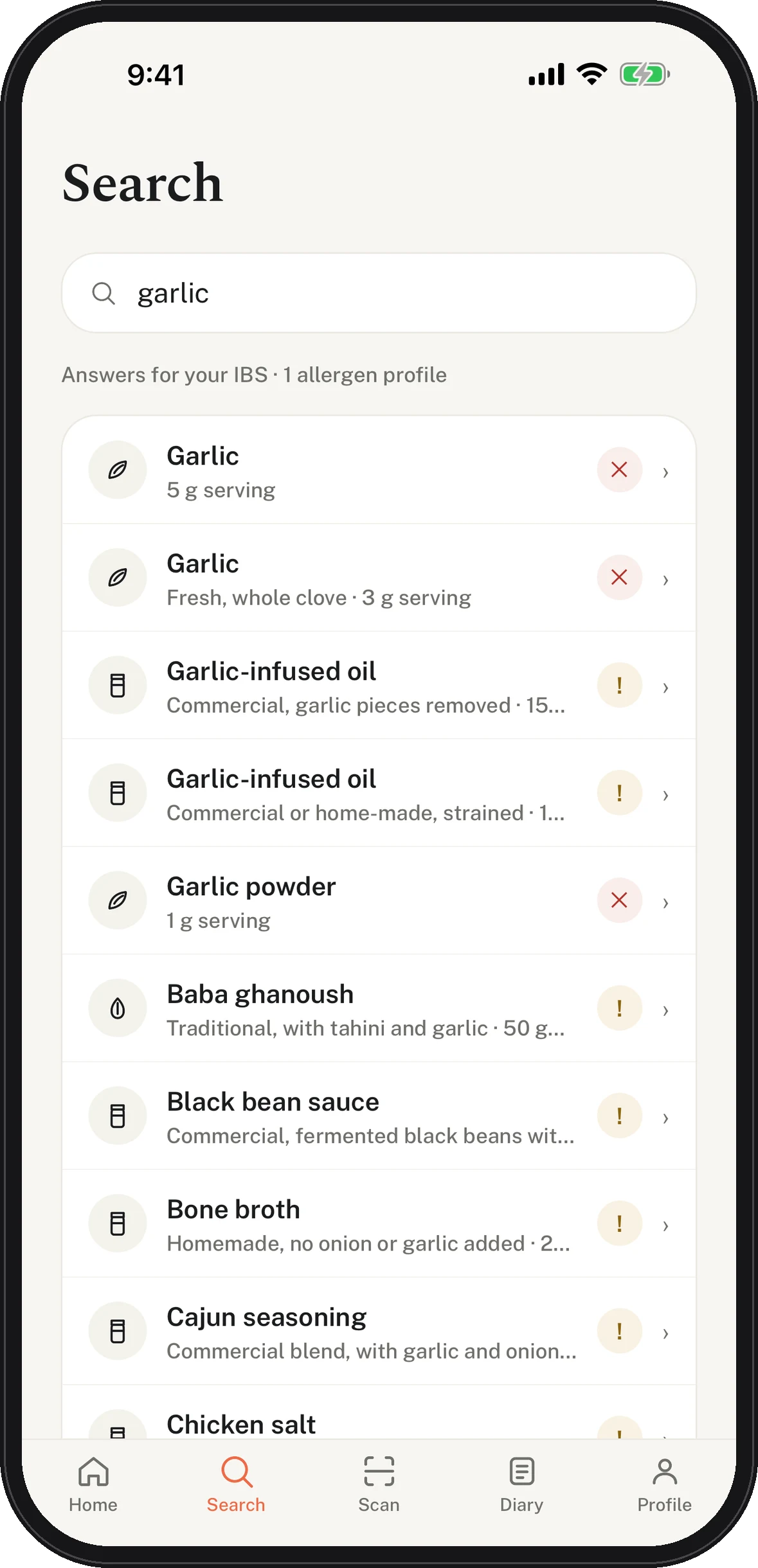
SafeBelly includes histamine intolerance as a condition you can choose, so aged cheese, cured meat or fermented foods come back with a clear answer and the reason. When it cannot be sure, it leans to "Eat this with care." rather than "Yes", and the diary and "How’s your belly?" check-in can help you and your clinician spot patterns during a guided trial.
SafeBelly is in final testing on iPhone and Android. Leave your email and we'll send one note the day it's in the App Store and on Google Play.
Frequently asked questions
What foods are highest in histamine?+
Aged and raw-milk cheeses, dry-fermented and cured sausages, canned or not-fresh fish, fermented vegetables such as sauerkraut, and alcoholic drinks such as wine and beer are most consistently linked to high histamine. Levels vary a lot with freshness, processing and storage.
Is histamine intolerance a real diagnosis?+
It is debated. Cleveland Clinic describes it as a proposed condition that experts consider controversial, and research reviews note there are no validated diagnostic criteria. Your symptoms are real, so it is worth working with a doctor to look at all possible causes.
Are leftovers high in histamine?+
Histamine can build up as protein-rich foods are stored, so fresher food generally carries lower risk. Refrigerate cooked food promptly and freeze portions you will not eat soon. Reheating does not remove histamine that has already formed.
Why do low-histamine food lists disagree?+
Histamine content varies with freshness, processing and storage, and some foods are listed as "histamine liberators" for reasons that have not been proven. Fermented foods and spoiled fish appear on almost every list, but foods like citrus, nuts, mushrooms and chocolate appear on only some.
Do DAO supplements work?+
The evidence is limited. A 2020 review found only five small or short intervention studies, which suggested possible benefit, and noted that some commercial products showed low enzyme activity in laboratory tests. Ask your clinician before trying one.
How long should a low-histamine diet last?+
Research reviews describe it as a short, structured trial followed by reintroduction, not a permanent change. A fully histamine-free way of eating is not achievable, so the aim is to find your own triggers and keep as much variety as possible, ideally with a dietitian.
Sources
- Histamine Intolerance: The Current State of the Art (Comas-Basté et al., 2020) · Biomolecules, via PubMed Central
- Histamine Intolerance—The More We Know the Less We Know. A Review (Hrubisko et al., 2021) · Nutrients, via PubMed Central
- Histamine Intolerance · Cleveland Clinic
- Fish and Fishery Products Hazards and Controls Guidance, Chapter 7: Scombrotoxin (Histamine) Formation · US Food and Drug Administration (FDA)
SafeBelly is a food information app, not a medical device, and no substitute for professional medical advice. Talk to your doctor or a registered dietitian before making changes to how you eat, and seek urgent care for severe or sudden symptoms.
Keep reading
Living with it
How to keep a food and symptom diary for IBS (without it taking over)
Conditions
Major food allergens: the US top 9, the EU and UK 14, and how to stay prepared
Conditions
Foods that cause bloating, and what else might be going on
Living with it
Food anxiety with IBS: understanding the fear and gently widening your plate