
Key points
- As of October 2026, McDonald’s US lists ingredients and the nine major US allergens for each item on its website and app.
- McDonald’s says it does not promote any US menu item as gluten-free, and that shared cooking areas, equipment and utensils mean cross-contact is possible.
- McDonald’s US fries and hash browns list a natural beef flavor made with wheat and milk derivatives, so both are listed as containing wheat and milk.
- For IBS, onion, garlic powder and high fructose corn syrup appear in several burgers, sauces and condiments.
- Recipes change. Check McDonald’s current ingredient information and tell the crew about your needs every time.
Can you eat at McDonald’s with celiac disease, IBS or a food allergy?
It depends on what you need to avoid, and McDonald’s is clear about its limits. As of October 2026, McDonald’s US says on its nutrition calculator page that it provides current supplier ingredient information for the nine major allergens identified by the FDA (eggs, dairy, wheat, soy, peanuts, tree nuts, fish, shellfish and sesame). It also says that normal kitchen operations may involve shared cooking and preparation areas, equipment and utensils, and that your food could come into contact with other foods, including allergens.
The same page states that McDonald’s does not promote any of its US menu items as vegetarian, vegan or gluten-free. So this guide doesn’t point to "gluten-free" or "allergy-safe" choices. Instead, it summarizes what McDonald’s own item pages list, so you can see where wheat, milk, egg, sesame and common FODMAP sources show up, and what to ask.
This guide covers the US menu only. Recipes differ by country and change over time; McDonald’s notes that product formulations change periodically and can vary by region. Check the current item page every time, and tell the crew about any allergy or celiac disease when you order. If you have a food allergy, carry your prescribed medication, and call emergency services for a severe reaction.
Fries and hash browns: wheat and milk in the flavoring
This one is worth knowing. As of October 2026, McDonald’s US fries page lists the frying oil as including natural beef flavor with wheat and milk derivatives, and explains that the natural beef flavor contains hydrolyzed wheat and hydrolyzed milk as starting ingredients. The fries are listed as containing wheat and milk.
The hash browns list the same natural beef flavor, and are also listed as containing wheat and milk.
Separately from the ingredients, fryers are a common cross-contact point in any kitchen. The Celiac Disease Foundation lists cross-contact from fryers as something to watch for with french fries. McDonald’s pages we checked don’t say which foods share fryer oil, so ask at your restaurant if it matters for your allergy.
For IBS, Monash lists potato as a lower-FODMAP vegetable. Whether fried food in general sits well with you is personal, and portion size can make a difference.
Burgers, buns and sauces (as of October 2026)
These are examples from McDonald’s US item pages when we checked them in October 2026. They describe what McDonald’s lists. They are not recommendations, and they can change.
| Item or component | Allergens McDonald’s lists | Also worth knowing |
|---|---|---|
| Regular bun (hamburger, cheeseburger) | Wheat; the hamburger is also listed as "may contain: sesame" | The bun ingredients include wheat flour and malted barley flour |
| Quarter Pounder and Big Mac buns | Wheat, sesame | Sesame seeds are an ingredient |
| Pasteurized process American cheese | Milk, soy | On cheeseburgers, the Quarter Pounder with Cheese, Big Mac and Egg McMuffin |
| Big Mac sauce | Egg, soy, wheat | Includes onion powder, garlic powder and a relish with high fructose corn syrup |
| Ketchup | None listed | Includes high fructose corn syrup |
| Onions, pickles, mustard | None listed | Onions are a common IBS trigger |
| Mayonnaise (McChicken) | Egg | |
| Tartar sauce (Filet-O-Fish) | Egg | Includes onions |
You can check these on McDonald’s Hamburger and Big Mac pages, which break each item into its components with their own ingredient and allergen lines.
You can ask for the bun or cheese to be left off. But FARE explains that peeling cheese off a cheeseburger is direct cross-contact, and that a spatula used for a cheeseburger can carry milk to a hamburger. If you have an allergy or celiac disease, ask for the item to be made without the component from the start, and ask about shared utensils. Our guide to burgers and fast food with food restrictions covers this in more detail.
Chicken, fish, breakfast and desserts
| Item | Allergens McDonald’s lists (as of October 2026) |
|---|---|
| Chicken McNuggets | Wheat |
| McChicken patty | Wheat (mayo: egg) |
| McCrispy chicken fillet and potato roll | Wheat (the potato roll includes honey; the butter is listed as milk) |
| McCrispy Strips | Wheat; the seasoning includes garlic powder and onion powder |
| Filet-O-Fish patty | Fish (pollock), wheat, milk |
| Egg McMuffin | Wheat (English muffin), egg, milk and soy (cheese), milk (butter) |
| Hotcakes | Wheat, egg, milk, soy |
| Fruit & Maple Oatmeal | Milk (light cream); the oatmeal includes barley malt extract, and the dried fruit blend contains sulfites |
| Apple Slices | None listed |
| McFlurry with OREO Cookies | Milk, wheat, soy |
| Vanilla cone | Milk, wheat (cone) |
| Baked apple pie | Wheat |
Two points stand out for celiac disease. First, the Fruit & Maple Oatmeal lists barley malt extract, and the Celiac Disease Foundation lists malt extract among sources of gluten, even though barley isn’t one of the nine labeled allergens. Second, the regular bun lists malted barley flour alongside wheat. Reading full ingredient lists, not just the allergen line, helps you catch barley and rye.
For IBS, Monash lists apples, honey and high fructose corn syrup among higher-FODMAP foods, and cow’s milk and ice cream as higher in lactose. That doesn’t mean you can’t have them; it depends on your triggers and the amount.
IBS at McDonald’s: where FODMAPs tend to appear
Based on McDonald’s US ingredient lists as of October 2026, the most common FODMAP sources are easy to spot once you know where to look:
- Onion: chopped onions on the hamburger, cheeseburger, Quarter Pounder and Big Mac; onions in the tartar sauce.
- Garlic and onion powder: in Big Mac sauce, the ranch sauce on the Snack Wrap and the McCrispy Strips seasoning.
- High fructose corn syrup: in ketchup and in the relish inside Big Mac sauce.
- Wheat: in buns, English muffins, tortillas, breaded chicken and fish, cones and pies.
- Lactose: in milk-based shakes, soft-serve and sundaes, and in cheese.
Asking for no onion and sauces on the side is a simple starting point. Our guides to hidden garlic and onion and eating out with IBS have more ideas, including how FODMAPs can stack up across a day.
How to order at McDonald’s with food restrictions
- Look up the item first on McDonald’s US website or app. Each item page has an allergen and ingredient section, broken down by component.
- Check every component, including sauces, cheese and the bun. Removing one part doesn’t change the rest.
- Order without the component from the start, rather than removing it later.
- Tell the crew about an allergy or celiac disease when you order, even if you use the app or a kiosk. Ask about shared utensils, grills and fryers.
- Check your order when it arrives. If something you asked to leave off is there and you have an allergy or celiac disease, ask for a fresh one.
- If you’re unsure, skip it. It’s fine to choose a sealed or simpler item, or eat elsewhere.
McDonald’s also invites customers with questions about its food to use its contact forms, which are linked from the nutrition calculator page.
Phrases to use at the counter
- "I have a milk allergy. Could you make this without cheese from the start, and change gloves?"
- "I have a sesame allergy. Which buns have sesame, and are they stored together?"
- "Is anything else cooked in the same oil as the fries?"
- "Could I have it with no onion and the sauce on the side?"
- "Can you show me the current allergen information for this item?"
For more on how to explain your needs clearly, see talking to restaurant staff about allergies and eating out with celiac disease.
How SafeBelly helps
Know before you eat.
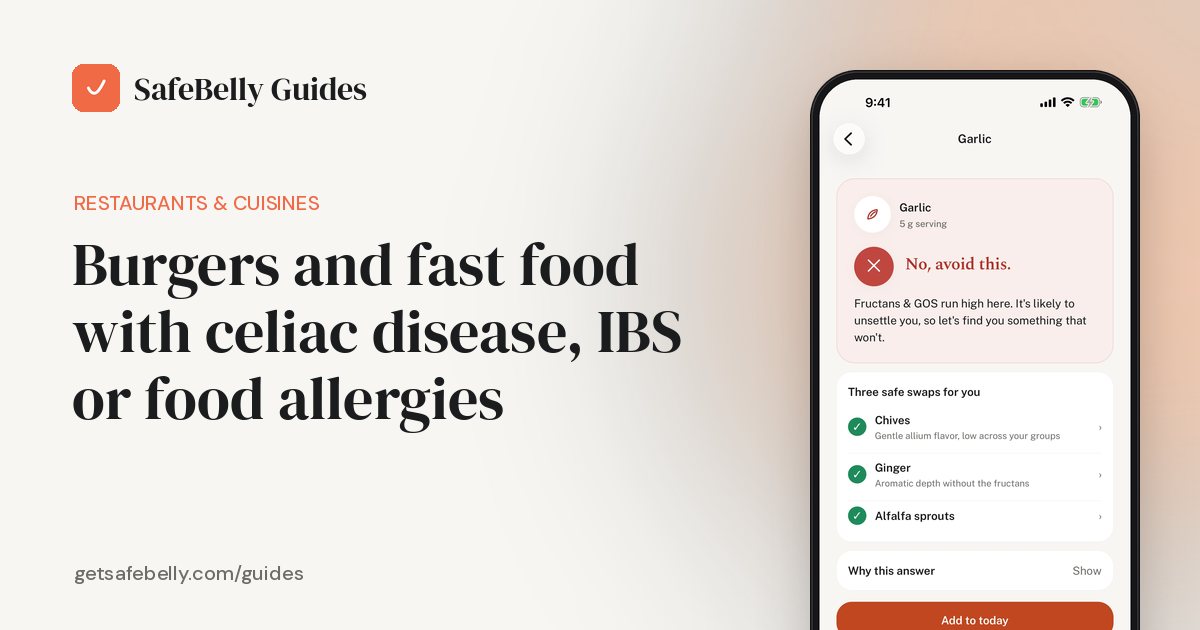
You can search a component such as fries, ketchup or a sauce in SafeBelly to see whether it’s a "Yes", "Eat this with care" or "No" for the conditions you’ve chosen, with the reason, and every check includes the 14 major allergens. For FODMAP-based conditions it shows small, typical and large portions. It’s a food information app, so McDonald’s current item pages and the crew still come first.
SafeBelly is in final testing on iPhone and Android. Leave your email and we'll send one note the day it's in the App Store and on Google Play.
Frequently asked questions
Are McDonald’s fries gluten-free in the US?+
As of October 2026, McDonald’s US lists its fries as containing wheat and milk, because the natural beef flavor in the frying oil is made with hydrolyzed wheat and hydrolyzed milk. McDonald’s also says it doesn’t promote any US menu item as gluten-free. Check the current item page, since recipes differ by country and change over time.
Does McDonald’s have anything gluten-free?+
McDonald’s US states that it does not promote any of its US menu items as gluten-free, and it notes shared cooking and preparation areas. Some items don’t list wheat as an allergen, but that isn’t the same as gluten-free, and barley can appear in ingredient lists. Decide with your care team what level of risk is acceptable for you.
Do McDonald’s buns contain sesame?+
As of October 2026, McDonald’s lists sesame for the Quarter Pounder and Big Mac buns, and its hamburger page says "may contain: sesame" for the regular bun. Ask about current buns and storage at your restaurant if you have a sesame allergy.
What can I eat at McDonald’s with IBS?+
It depends on your triggers. McDonald’s US ingredient lists show onion, garlic powder and high fructose corn syrup in several burgers, sauces and ketchup, and wheat in the buns and breaded items. Asking for no onion and sauces on the side is a common starting point.
Does McDonald’s list allergens?+
Yes. As of October 2026, McDonald’s US gives ingredient information for the nine major US allergens on each item page and in its nutrition calculator. It also warns that shared areas, equipment and utensils mean cross-contact with allergens is possible.
Is McDonald’s oatmeal gluten-free?+
McDonald’s doesn’t describe it as gluten-free. As of October 2026, its Fruit & Maple Oatmeal lists barley malt extract in the oatmeal, and barley contains gluten. Its allergen line shows milk, which doesn’t capture barley, so read the full ingredient list.
Sources
- Nutrition Calculator (allergen statement) · McDonald’s USA
- World Famous Fries: Allergen Information · McDonald’s USA
- Hamburger: Allergen Information · McDonald’s USA
- Big Mac: Allergen Information · McDonald’s USA
- Fruit & Maple Oatmeal: Allergen Information · McDonald’s USA
- Sources of Gluten · Celiac Disease Foundation
- How to Avoid Cross-Contact · Food Allergy Research & Education (FARE)
- High and low FODMAP foods · Monash University FODMAP
SafeBelly is a food information app, not a medical device, and no substitute for professional medical advice. Talk to your doctor or a registered dietitian before making changes to how you eat, and seek urgent care for severe or sudden symptoms.
Keep reading
Restaurants & cuisines
Burgers and fast food with celiac disease, IBS or food allergies

Eating out & travel
Eating out with celiac disease: questions to ask and what to watch

Food & labels
Hidden garlic and onion: foods that contain them and how to spot them

Eating out & travel
How to tell a restaurant about a food allergy (and what to ask)